
Steve Sanders and the Golden Age of the Arcade
Before Steve Sanders became a trial attorney and the founder of Sanders.Law, he was a teenager from Clinton, Missouri, who spent the early 1980s in arcades. In 1982 his Donkey Kong score of 270,000 topped the national scoreboard that Twin Galaxies was building. That same year Bantam Books published his strategy guide. In July 1983 he was captain of the team of top players at the Electronic Circus in Boston. Decades later he went back to the game Joust and set records in the two-player game, and he appears in the documentaries The King of Kong and Chasing Ghosts.
This page also covers the part Steve could have left out. After his genuine 270,000, he claimed scores he never earned. Then he admitted it in writing and apologized. He tells that part himself because accountability is the same standard he holds trucking companies to in court.

The 1982 Donkey Kong record
On March 1, 1982, in Shawnee, Kansas, Steve scored 270,000 points on Donkey Kong. Walter Day's Twin Galaxies, in Ottumwa, Iowa, kept the national scoreboard. It ranked that score first in the country, and the first issue of Video Games magazine published the list in August 1982.[2] Twin Galaxies' 1998 record book lists Steve's 270,000 in its Donkey Kong table.[3] Walter Day's 2007 record book says that for the first 25 years of organized classic arcade gaming, Steve held 2nd place on Donkey Kong.[4]
Walter Day called Steve "our first superstar."[5]
Personal best: 863,500 (seven-life setting)


Steve kept slides he shot of the arcade screen. The clearest one shows a high score of 863,500. National scoreboards printed the same score in 1982: the Arcade Express "Honor Roll" (Oct. 10, 1982), and a Joystik scoreboard compiled by Walter Day, which dates it July 10, 1982, at Meadow Lark Lanes in Clinton, Missouri.[8][9] Steve submitted the score to both lists himself.[10] In 1983 Steve told Computer Games he scored 863,500 "using seven men on the original chip," not Twin Galaxies' standard three-life setting.[7][11][3]
On Twin Galaxies tournament settings (three lives, one bonus life at 7,000 points), Steve recalls a personal best of 552,400 points in the spring of 1983, at an arcade near 102nd and Wornall in south Kansas City, with Electronic Circus teammate Pete Corpeny on the stool beside him.[12][13] It was not a record: Billy Mitchell had scored 874,300 at Twin Galaxies in Ottumwa in November 1982.[14]
The book: The Video Master's Guide to Donkey Kong

As a teenager, Steve wrote a strategy guide to Donkey Kong, with patterns for the barrels, rivets, elevators and conveyor belts. Bantam Books published The Video Master's Guide to Donkey Kong in June 1982 (ISBN 0-553-23072-7).[15][16][4][17][18] Bantam later told Steve the book sold about 38,000 copies.[19]
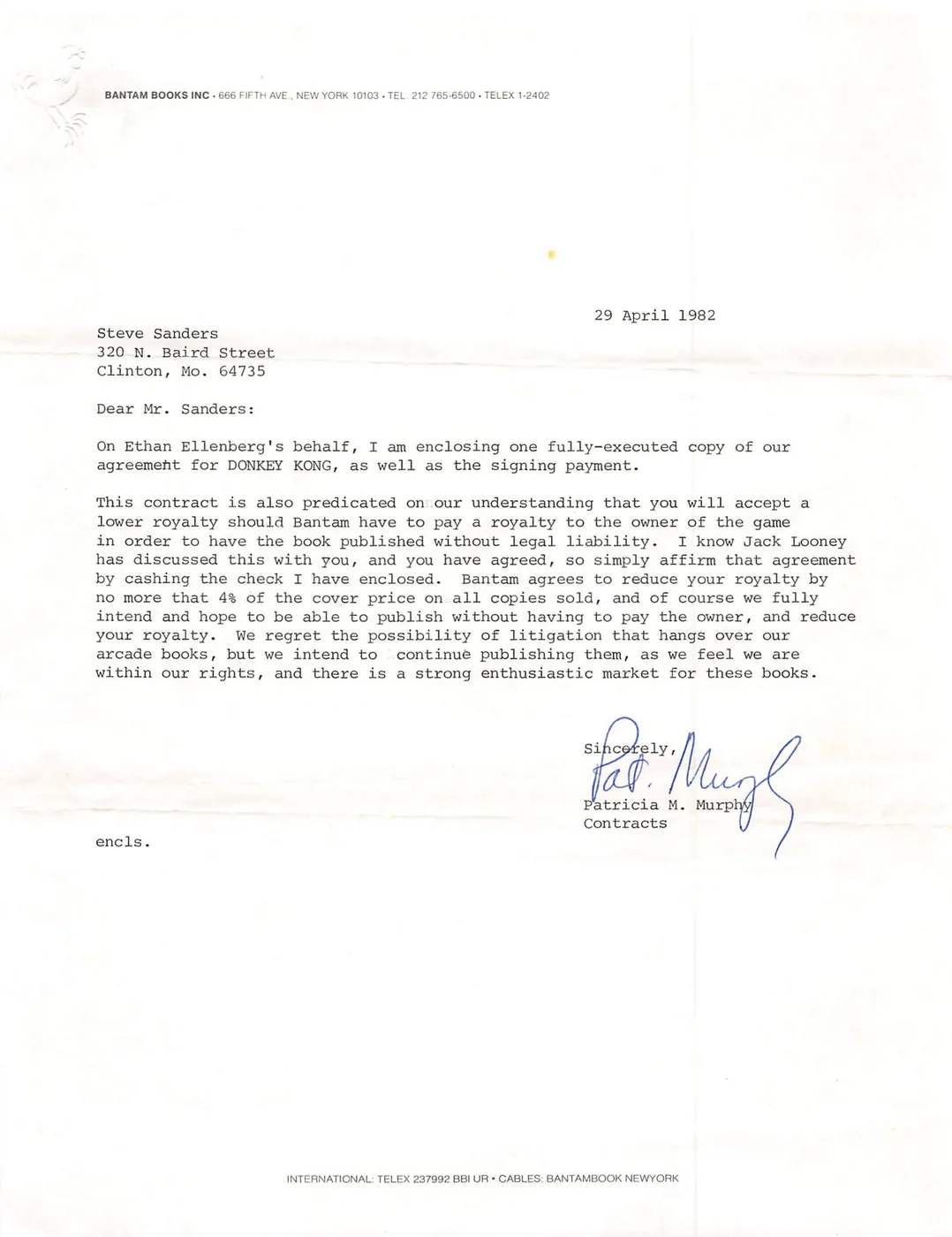
Before Donkey Kong: a Pac-Man win in 1981

As a high school senior, Steve won a Pac-Man contest in Lawrence, Kansas, and took home the machine.[20] In a Pac-Man contest in Lawrence, Kansas, that ended October 31, 1981, Steve scored 2,886,030 points.[20] Walter Day's 2007 record book calls it a then-world record.[4]
Ottumwa, That's Incredible, and the Electronic Circus

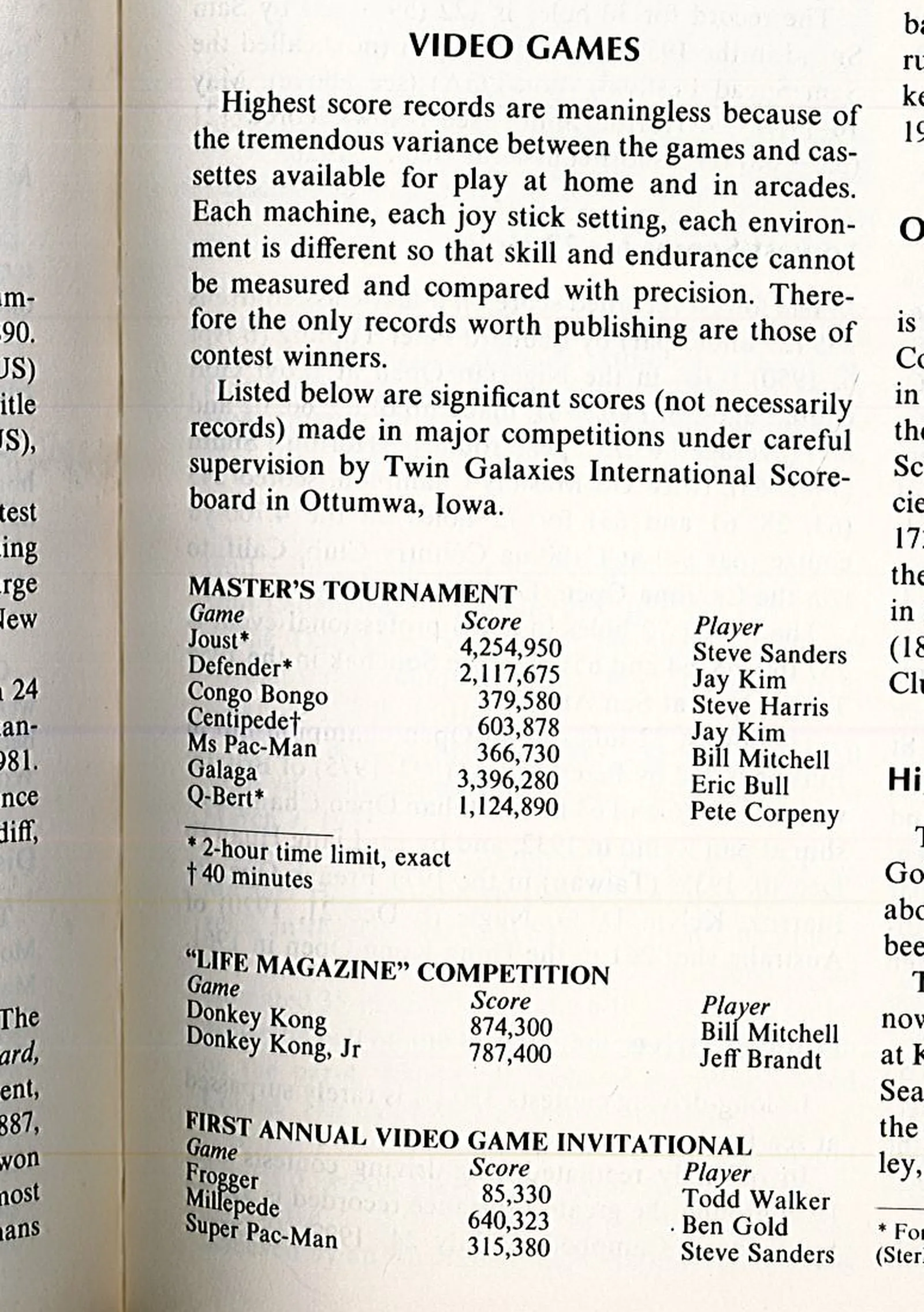
On January 8–9, 1983, Steve was one of 19 players at the North American Video Game Olympics in Ottumwa, Iowa, taped for ABC's That's Incredible. He finished sixth, and his Super Pac-Man score there, 315,380, was a world record at the time by Twin Galaxies' count.[21][22][23][4][24][25]

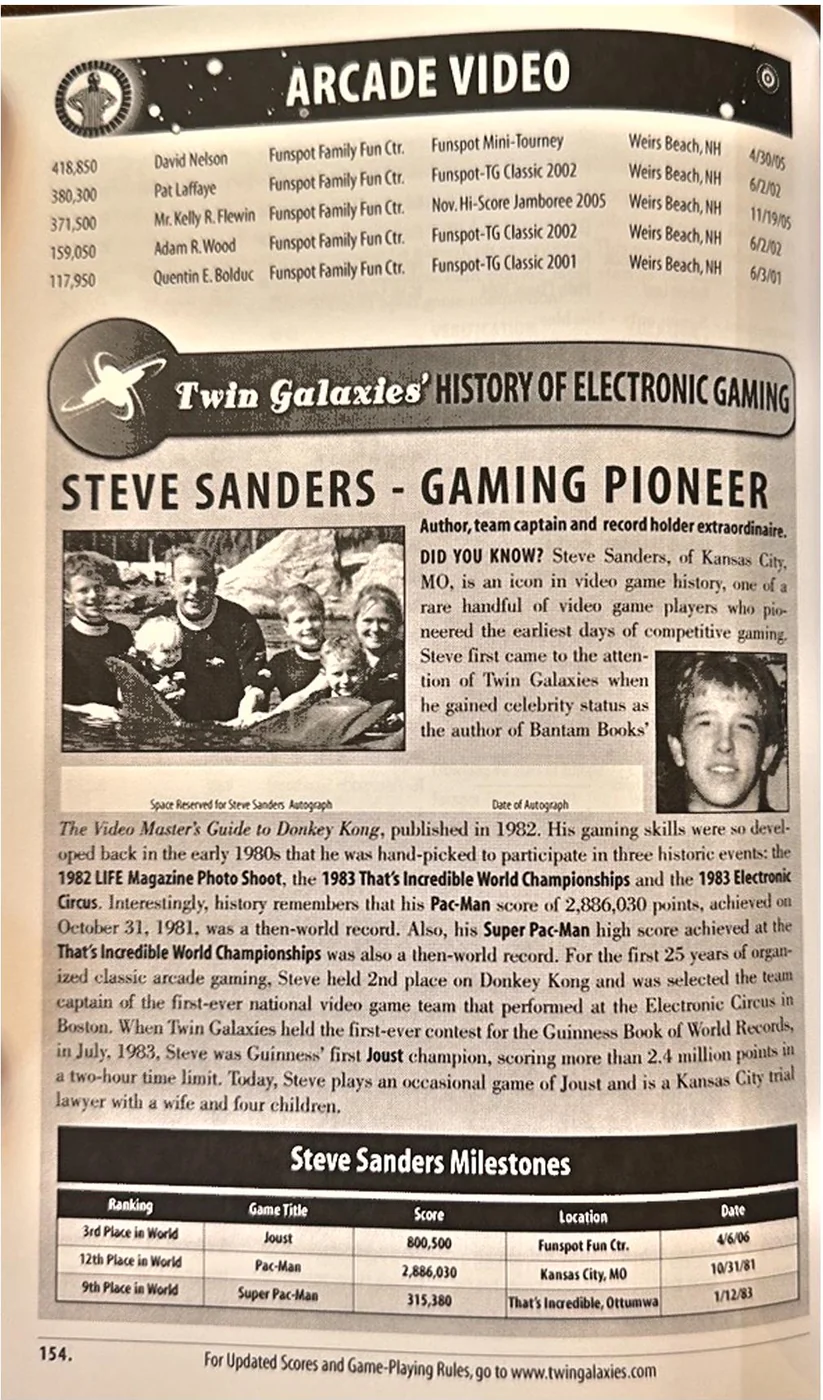
That July, promoter Jim Riley named him captain of the Electronic Circus team, a troupe of top video game players that performed in Boston.[7][13] Walter Day's 2007 record book calls it the first-ever national video game team.[4]
"The King of Kong," 1983

On March 6, 1983, The Kansas City Star put Steve on the cover of its Sunday Star Magazine under the headline "The King of Kong: A young man from Clinton finds fame at the arcade."[26] That 1983 headline came more than 20 years before the 2007 documentary of the same name, and it's why Steve goes by "The Original King of Kong." The same story also printed a false Donkey Kong score, which Steve later admitted to. That's covered in the next section, and the full story is reprinted under "In the press."
Owning a mistake
His 270,000 from March 1982 still appears in Twin Galaxies' 1998 record book.[3][27] What came after it was not genuine. When other players passed his scores, he started reporting higher Donkey Kong scores he had never reached, including 1,400,000, 3,151,800 and 3,165,300.[11][28][7] Steve says every false Donkey Kong score he reported was over 900,000.[29] The Kansas City Star printed one of them in 1983.[26]
At the Ottumwa photo weekend in November 1982, he played Billy Mitchell head to head. "I got 200,000 against Bill," Steve says in The King of Kong. "He shellacked me." The Pitch reported that he "couldn't break 200,000 points a game." Mitchell scored 874,300 that weekend.[14] "After that, I knew they looked at me with some skepticism," Steve told The Pitch years later.[5] On April 6, 1983, he put the truth in writing, in a typed letter addressed to Twin Galaxies and twelve top players, Billy Mitchell among them. In it he admitted that he had lied, and he apologized.[11][7][5] The same letter gave his real Donkey Kong highs: 550,000 on the harder chip with four lives, and 863,500 on an easier machine set to seven lives.[11] Steve has said that Mitchell forgave him and became one of his best friends.[30][31] Years later Walter Day said, "I think a lot of players were genuinely impressed that Steve had the sand to fess up to it and to apologize and to go on with his life."[5]
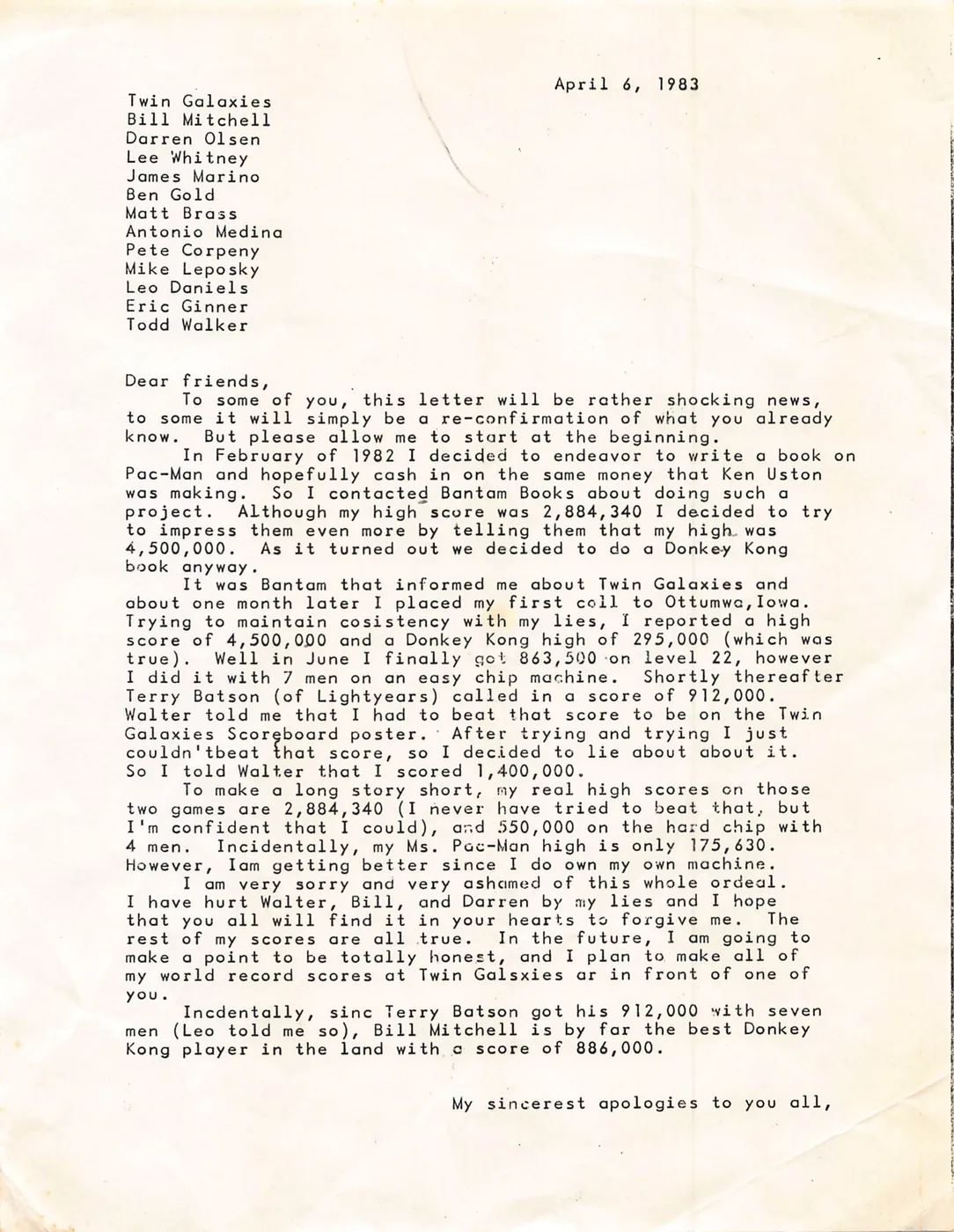

In Steve's own words, from Retro Gamer:
"I learned the hard way that nothing good comes from lying. The truth will out. Better to be on the side of the truth when it does."[31]
Steve, looking back today:
"I set a real record, and then I lied to keep a title I'd already lost. Writing that letter was the hardest thing I'd done at 18, and the most important. When you cause harm, you own it and you make it right. I hold myself to that, and it's what I ask of every company I face in court."
Back in the game: Joust

Steve's road back to Joust started with a film. In 2005, Seth Gordon and Ed Cunningham were making the documentary that became The King of Kong, and Steve says they hadn't yet decided to center it on Donkey Kong. As he tells it, they wanted the original players of the early 1980s to sharpen their skills, and with Walter Day's help they arranged a contest for them. He was invited in 2005 and started practicing at home that year.[32] The contest was the "Toughest Gun in Dodge City" tournament in Florida, April 6–9, 2006, Steve's first Joust in about 20 years.[33][34] During the filming, Billy Mitchell asked him, "Why don't you go after the Joust score again?"[5] Walter Day's 2007 record book also calls Steve "Guinness' first Joust champion," from the first contest Twin Galaxies held for the Guinness Book of World Records, in July 1983. The Guinness Book of World Records 1984 lists his Joust score in its "Master's Tournament" table as 4,254,950, with a two-hour time limit.[4][24][35] In June 2006 he and Donald Hayes scored 600,750 points in two-player Joust. The Pitch reported that Guinness World Records 2007 lists Steve as a Joust doubles world record holder.[5] In January 2011, The Pitch reported that he and his son Isaiah had set a Joust doubles world record as a father-and-son team.[36][37]
Twin Galaxies trading cards created by Walter Day (keepsakes, not independent records):
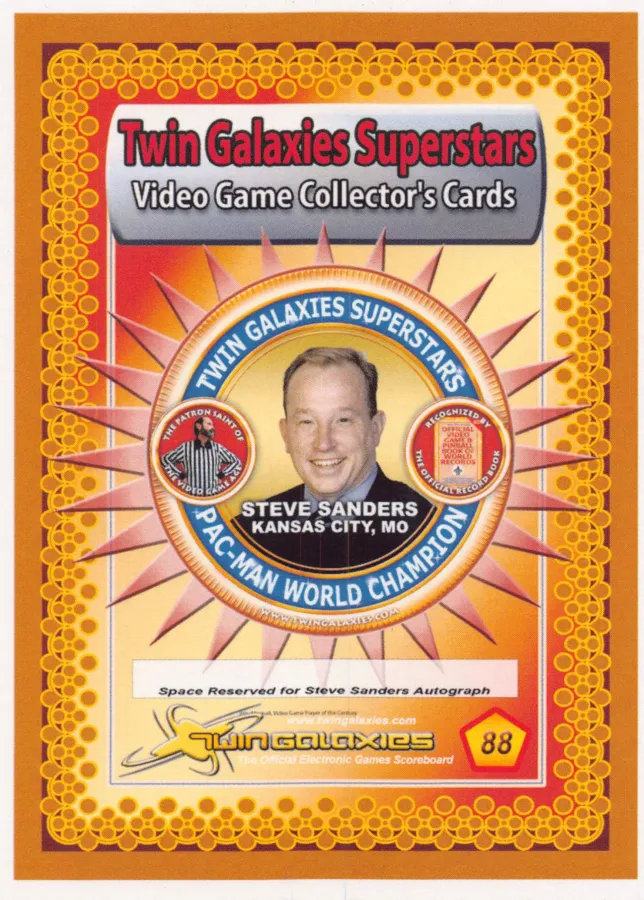
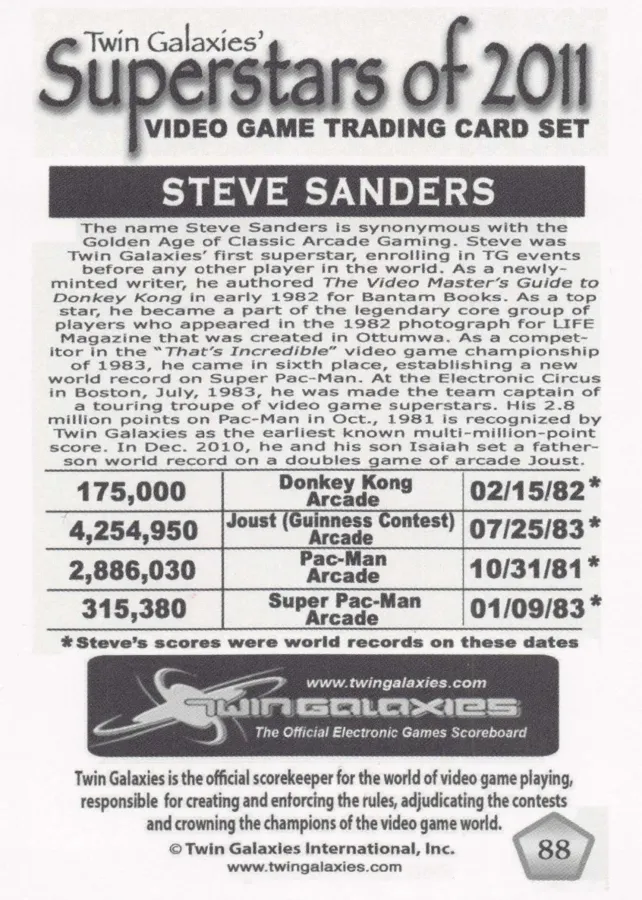
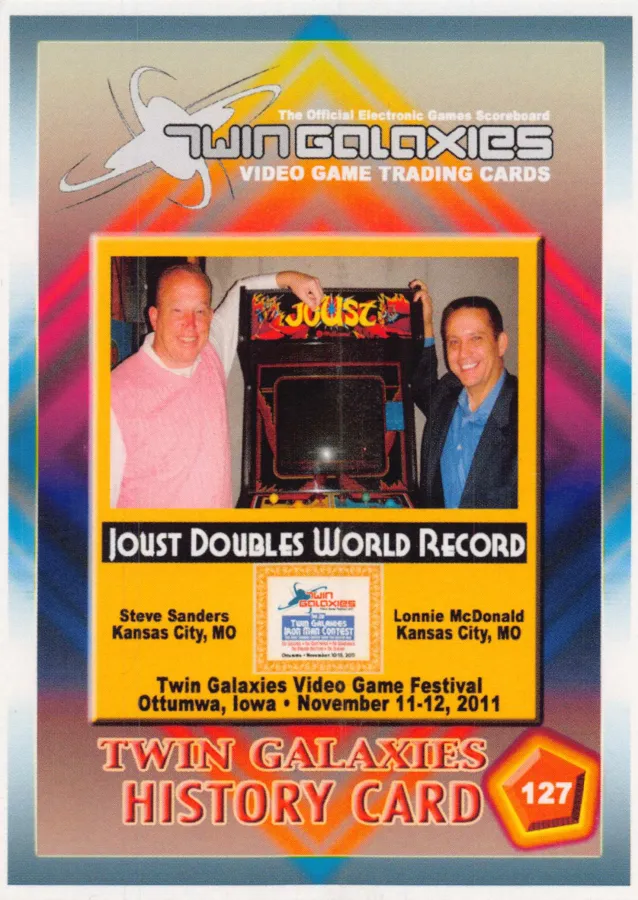
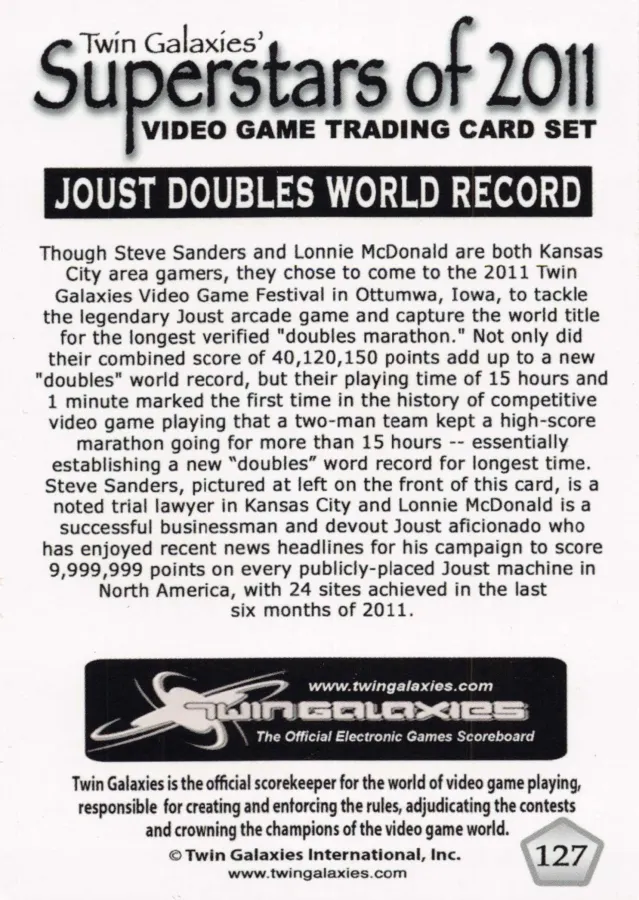
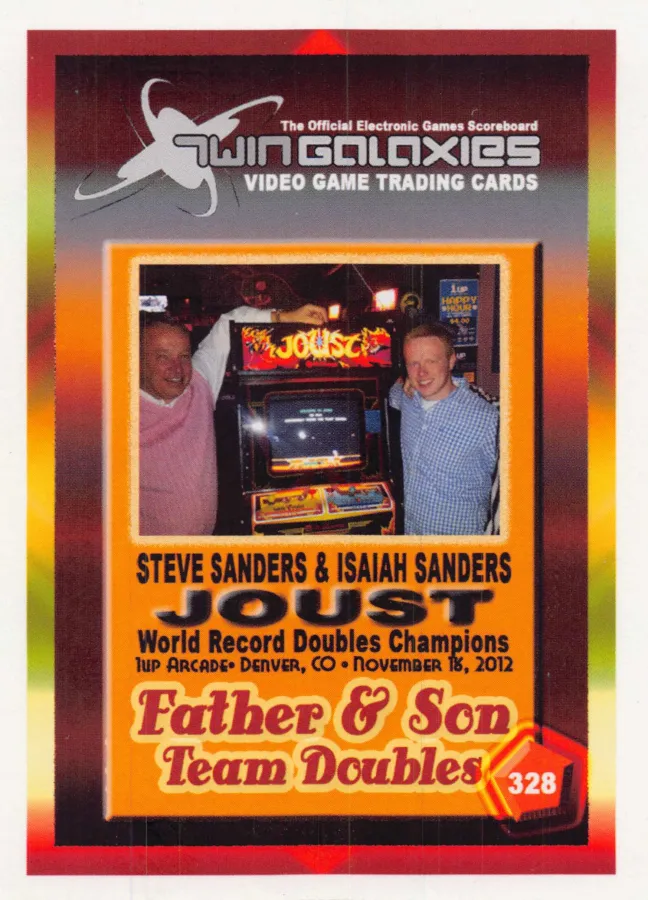
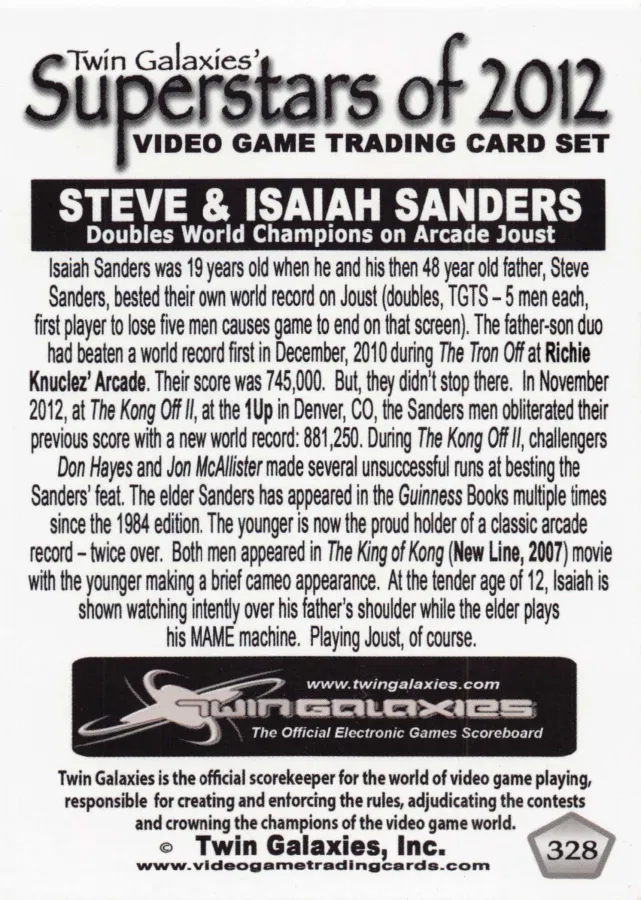

On screen
Steve appears as himself in The King of Kong: A Fistful of Quarters (2007), the documentary about Steve Wiebe and Billy Mitchell's contest over the Donkey Kong high score.[39][40][41] He is also in Chasing Ghosts: Beyond the Arcade (2007), which premiered at the Sundance Film Festival. It tracked down the players from the 1982 LIFE photo.[42][43] He appears in Arcades & Love Songs: The Ballad of Walter Day (2025) as well.[44]
When the International Video Game Hall of Fame opened in Ottumwa in August 2010, Steve received an award of recognition.[45] CNN's coverage of the opening included a photo of him playing at the launch party.[46]
In the press
- The Pitch (Kansas City), Jan. 15, 2009: "For disgraced former Joust king Steve Sanders, there's life after the arcade," by Peter Rugg. Read it
- Missouri Lawyers Media, Aug. 17, 2007: "Kansas City's 'King of Kong' makes big-screen debut." Read it
- The Pitch, Jan. 21, 2011: "Steve and Isaiah Sanders, father and son video-game champs, take Joust world record for doubles," by Peter Rugg. Read it
- The Pitch, Aug. 5, 2010: "International Video Game Hall of Fame honors but doesn't induct Joust champ Steve Sanders," by Peter Rugg. Read it
- The Pitch "Pitchcast," Sept. 27, 2007: "Kansas City's King of Kong," by Eric Barton. Listen
- CNN, Aug. 18, 2010: "The importance of video game history," by Scott Steinberg. Archived copy
- The Landmark (Platte County, Mo.), Sept. 5, 2007: "He's the King of Kong," by Stacy Wiedmaier. Archived copy
- The Kansas City Star, Jan. 22, 2007: "Local man a featured arcade king," by James Hart. (No online copy found. Steve has a saved copy.)
- The Kansas City Star, April 10, 2006: "20 years removed from battle, knight defends honor in Joust," by James Hart. (Clipping shown above. No online copy verified.)
- The Kansas City Star, Star Magazine, March 6, 1983: "The King of Kong," by James Augustus Baggett. (Page shown above.)
- Video Games magazine, Aug. 1982, p. 14: Twin Galaxies' national top scores, including Steve's 270,000 on Donkey Kong. Internet Archive
- Computer Games, Dec. 1983/Jan. 1984: Twin Galaxies feature with Steve's account. Internet Archive
- Retro Gamer (UK), issue 31 (2006): "High Score" profile of Steve. Internet Archive collection · issue 171 (2017): Donkey Kong feature with Steve's interview. Internet Archive collection
Press reprints
Four articles, reprinted in full. The original wording is unchanged, mistakes included. Numbered notes mark the mistakes and give the correct facts and sources.
"Kong King Turns Entrepreneur," The Maneater (University of Missouri-Columbia), The Mews, February 4, 1983
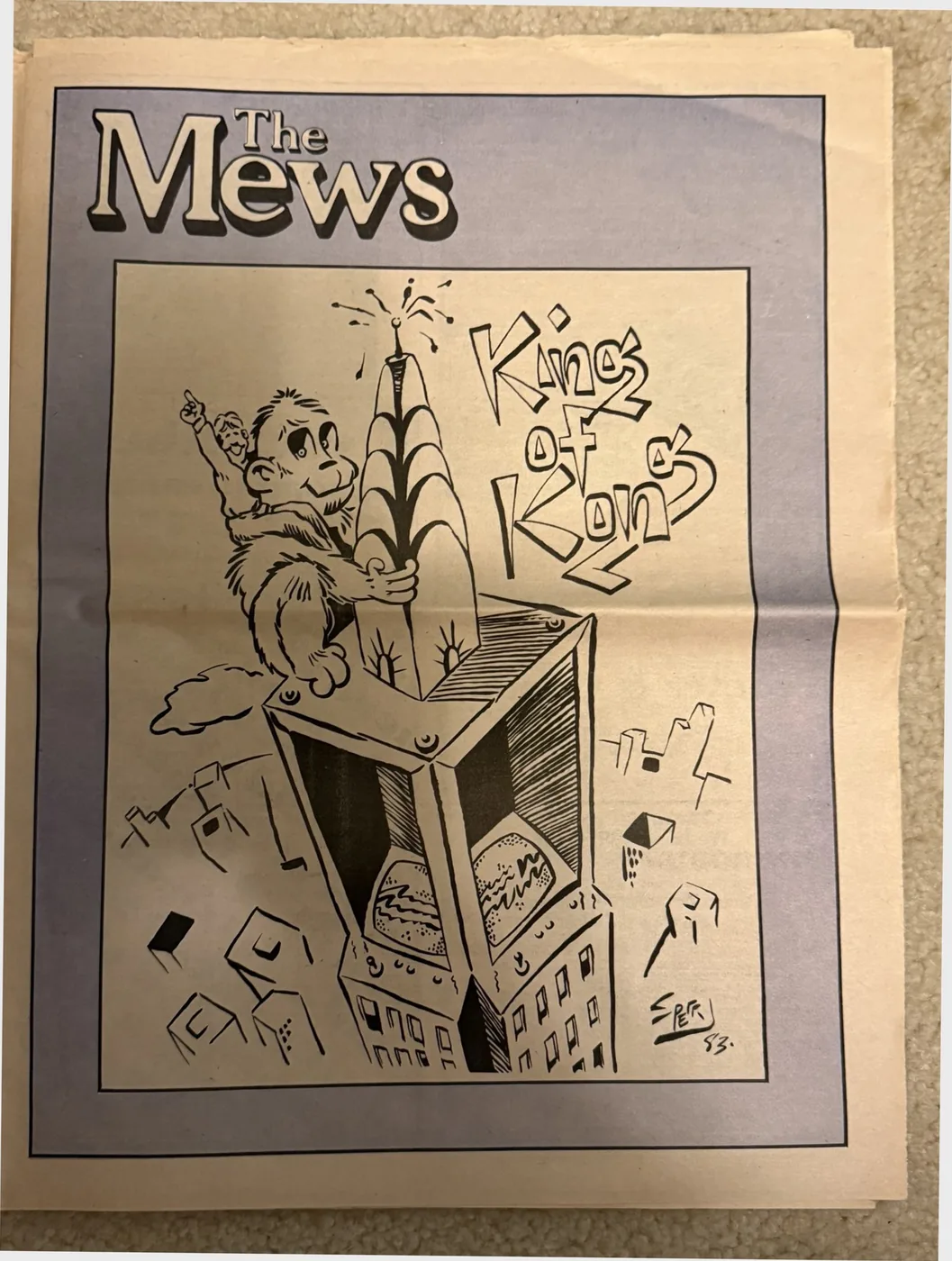
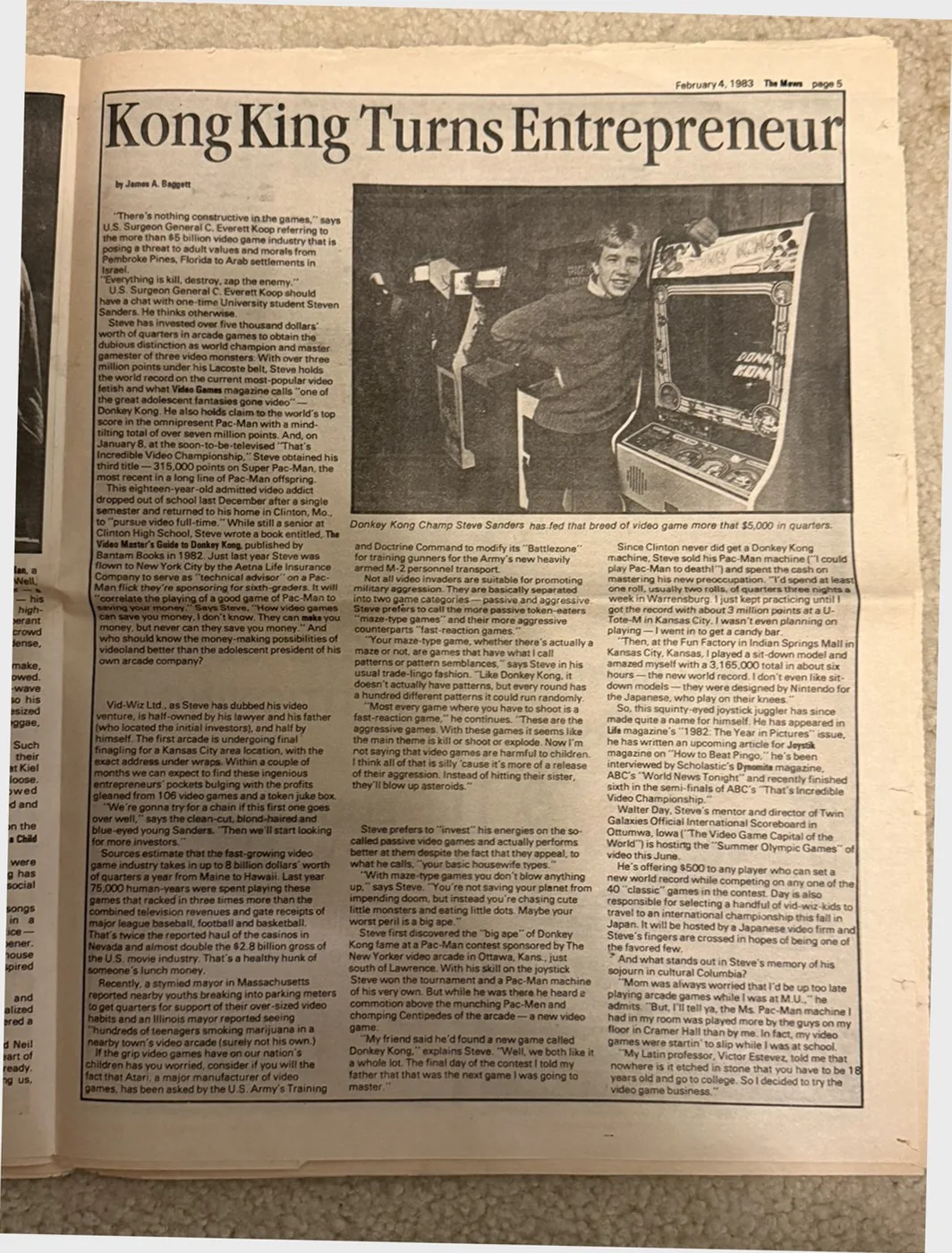
Kong King Turns Entrepreneur
By James A. Baggett
"There's nothing constructive in the games," says U.S. Surgeon General C. Everett Koop referring to the more than $5 billion video game industry[1] that is posing a threat to adult values and morals from Pembroke Pines, Florida to Arab settlements in Israel.
"Everything is kill, destroy, zap the enemy."
U.S. Surgeon General C. Everett Koop should have a chat with one-time University student Steven Sanders. He thinks otherwise.
Steve has invested over five thousand dollars' worth of quarters in arcade games to obtain the dubious distinction as world champion and master gamester of three video monsters[2]. With over three million points under his Lacoste belt[3], Steve holds the world record on the current most-popular video fetish and what Video Games magazine calls "one of the great adolescent fantasies gone video"—Donkey Kong. He also holds claim to the world's top score in the omnipresent Pac-Man with a mind-tilting total of over seven million points[4]. And, on January 8, at the soon-to-be-televised "That's Incredible Video Championship," Steve obtained his third title—315,000 points on Super Pac-Man[5], the most recent in a long line of Pac-Man offspring.
This eighteen-year-old admitted video addict dropped out of school last December after a single semester and returned to his home in Clinton, Mo., to "pursue video full-time." While still a senior at Clinton High School, Steve wrote a book entitled, The Video Master's Guide to Donkey Kong, published by Bantam Books in 1982. Just last year Steve was flown to New York City by the Aetna Life Insurance Company to serve as "technical advisor" on a Pac-Man flick they're sponsoring for sixth-graders. It will "correlate the playing of a good game of Pac-Man to saving your money." Says Steve, "How video games can save you money, I don't know. They can make you money, but never can they save you money." And who should know the money-making possibilities of videoland better than the adolescent president of his own arcade company?
Vid-Wiz Ltd., as Steve has dubbed his video venture, is half-owned by his lawyer and his father (who located the initial investors), and half by himself. The first arcade is undergoing final finagling for a Kansas City area location, with the exact address under wraps. Within a couple of months we can expect to find these ingenious entrepreneurs' pockets bulging with the profits gleaned from 106 video games and a token juke box.
"We're gonna try for a chain if this first one goes over well," says the clean-cut, blond-haired and blue-eyed young Sanders. "Then we'll start looking for more investors."
Sources estimate that the fast-growing video game industry takes in up to 8 billion dollars' worth of quarters a year from Maine to Hawaii. Last year 75,000 human-years were spent playing these games that racked in three times more than the combined television revenues and gate receipts of major league baseball, football and basketball. That's twice the reported haul of the casinos in Nevada and almost double the $2.8 billion gross of the U.S. movie industry. That's a healthy hunk of someone's lunch money.
Recently, a stymied mayor in Massachusetts reported nearby youths breaking into parking meters to get quarters for support of their over-sized video habits and an Illinois mayor reported seeing hundreds of teenagers smoking marijuana in a nearby town's video arcade (surely not his own.)
If the grip video games have on our nation's children has you worried, consider if you will the fact that Atari, a major manufacturer of video games, has been asked by the U.S. Army's Training and Doctrine Command to modify its "Battlezone" for training gunners for the Army's new heavily armed M-2 personnel transport.
Not all video invaders are suitable for promoting military aggression. They are basically separated into two game categories—passive and aggressive. Steve prefers to call the more passive token-eaters "maze-type games" and their more aggressive counterparts "fast-reaction games."
"Your maze-type game, whether there's actually a maze or not, are games that have what I call patterns or pattern semblances," says Steve in his usual trade-lingo fashion. "Like Donkey Kong, it doesn't actually have patterns, but every round has a hundred different patterns it could run randomly.
"Most every game where you have to shoot is a fast-reaction game," he continues. "These are the aggressive games. With these games it seems like the main theme is kill or shoot or explode. Now I'm not saying that video games are harmful to children. I think all of that is silly 'cause it's more of a release of their aggression. Instead of hitting their sister, they'll blow up asteroids."
Steve prefers to "invest" his energies on the so-called passive video games and actually performs better at them despite the fact that they appeal, to what he calls, "your basic housewife types."
"With maze-type games you don't blow anything up," says Steve. "You're not saving your planet from impending doom, but instead you're chasing cute little monsters and eating little dots. Maybe your worst peril is a big ape."
Steve first discovered the "big ape" of Donkey Kong fame at a Pac-Man contest sponsored by The New Yorker video arcade in Ottawa, Kans., just south of Lawrence[6]. With his skill on the joystick Steve won the tournament and a Pac-Man machine of his very own. But while he was there he heard a commotion above the munching Pac-Men and chomping Centipedes of the arcade—a new video game.
"My friend said he'd found a new game called Donkey Kong," explains Steve. "Well, we both like it a whole lot. The final day of the contest I told my father that that was the next game I was going to master."
Since Clinton never did get a Donkey Kong machine, Steve sold his Pac-Man machine ("I could play Pac-Man to death!") and spent the cash on mastering his new preoccupation. "I'd spend at least one roll, usually two rolls, of quarters three nights a week in Warrensburg. I just kept practicing until I got the record with about 3 million points at a U-Tote-M[7] in Kansas City. I wasn't even planning on playing—I went in to get a candy bar.
"Then, at the Fun Factory in Indian Springs Mall in Kansas City, Kansas, I played a sit-down model and amazed myself with a 3,165,000 total in about six hours—the new world record[8]. I don't even like sit-down models—they were designed by Nintendo for the Japanese, who play on their knees.[9]"
So, this squinty-eyed joystick juggler has since made quite a name for himself. He has appeared in Life magazine's "1982: The Year in Pictures" issue, he has written an upcoming article for Joystik magazine on "How to Beat Pingo," he's been interviewed by Scholastic's Dynomite magazine, ABC's "World News Tonight" and recently finished sixth in the semi-finals[10] of ABC's "That's Incredible Video Championship."
Walter Day, Steve's mentor and director of Twin Galaxies Official International Scoreboard in Ottumwa, Iowa ("The Video Game Capital of the World") is hosting the "Summer Olympic Games" of video this June.
He's offering $500 to any player who can set a new world record while competing on any one of the 40 "classic" games in the contest. Day is also responsible for selecting a handful of vid-wiz-kids to travel to an international championship this fall in Japan. It will be hosted by a Japanese video firm and Steve's fingers are crossed in hopes of being one of the favored few.
And what stands out in Steve's memory of his sojourn in cultural Columbia?
"Mom was always worried that I'd be up too late playing arcade games while I was at M.U.," he admits. "But, I'll tell ya, the Ms. Pac-Man machine I had in my room was played more by the guys on my floor in Cramer Hall than by me. In fact, my video games were startin' to slip while I was at school.
"My Latin professor, Victor Estevez, told me that nowhere is it etched in stone that you have to be 18 years old and go to college. So I decided to try the video game business."
Corrections and notes (Sanders.Law, 2026)
- These industry figures, here and later in the article, are the reporter's. Sanders.Law has not checked them. ↩
- Not a world champion. The "three" rests on the two false scores below and on the January 1983 contest, which was not a title. ↩
- False. Steve invented his 3-million-point Donkey Kong scores and admitted it in a letter dated April 6, 1983. His genuine score was 270,000 on March 1, 1982 (Video Games, Aug. 1982, p. 14; Twin Galaxies 1998 book, p. 79). See "Owning a mistake" above. ↩
- False, and not possible: the highest possible Pac-Man score is 3,333,360 (Guinness World Records, "First perfect score on PAC-Man"). Steve's real best was 2,886,030 (Clinton Daily Democrat, Nov. 5, 1981, p. 1). ↩
- The score was 315,380, and it was not a title. Steve finished sixth at the Jan. 8–9, 1983 championship in Ottumwa, Iowa (Twin Galaxies 1998 book, pp. 154 and 798). The 1984 Guinness Book of World Records (Sterling, p. 415) lists the score among "significant scores (not necessarily records)." ↩
- Wrong town. The contest was at the New Yorker arcade in Lawrence, Kansas, and ended Oct. 31, 1981 (Clinton Daily Democrat, Nov. 5, 1981). ↩
- False; see note 3. JoyStik (Jan. 1983, p. 71) printed this invented score as 3,151,800. ↩
- False; see note 3. JoyStik (July 1983) and LIFE printed this invented score as 3,165,300. ↩
- This is Steve's 1983 remark, not a fact. We found nothing to support it. ↩
- He finished sixth overall at the January 1983 championship (Twin Galaxies 1998 book, p. 798), which also contradicts the "third title" claim above. ↩
"The King of Kong," The Kansas City Star, Star Magazine, March 6, 1983

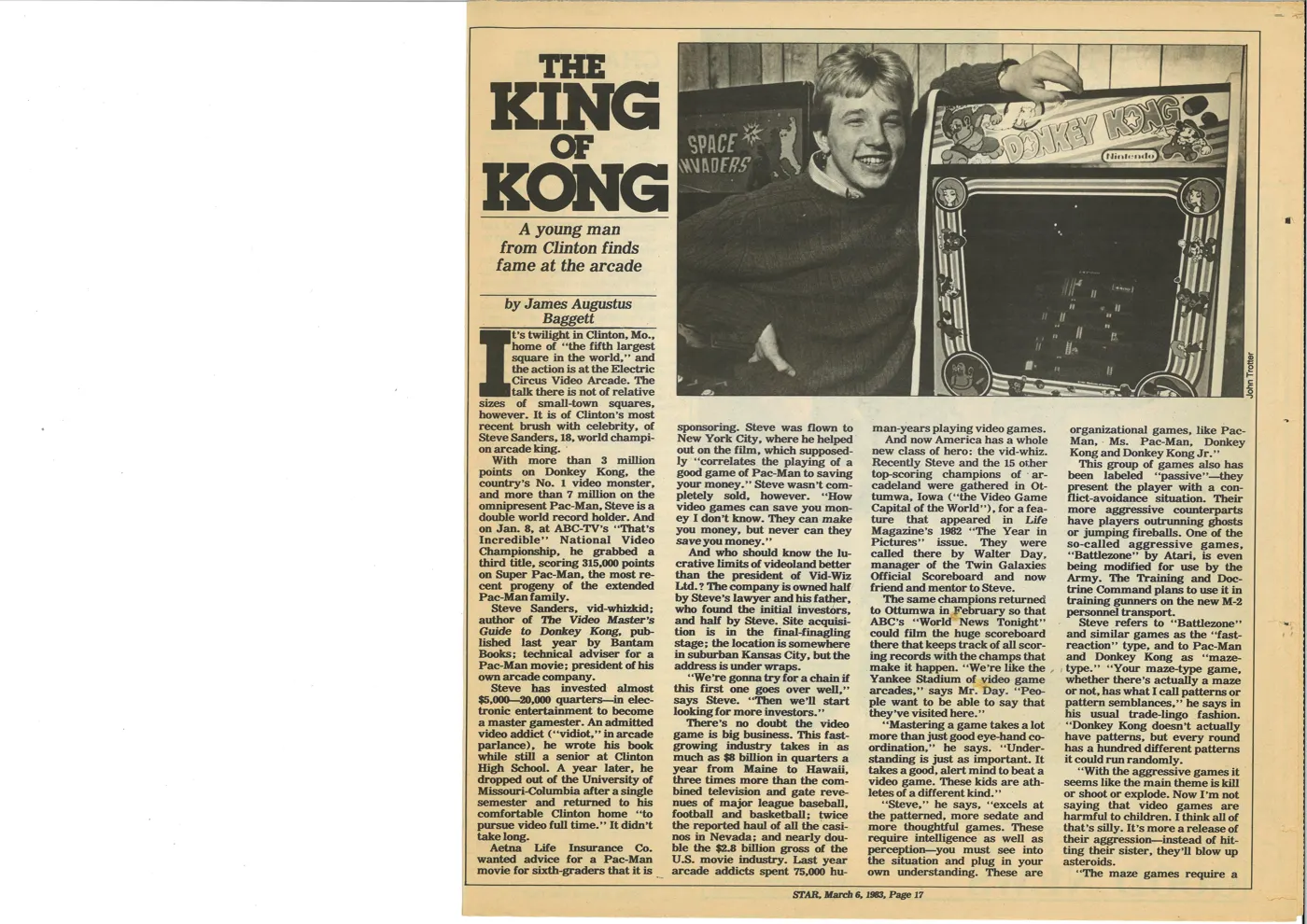
The King of Kong
A young man from Clinton finds fame at the arcade
By James Augustus Baggett
It's twilight in Clinton, Mo., home of "the fifth largest square in the world," and the action is at the Electric Circus Video Arcade. The talk there is not of relative sizes of small-town squares, however. It is of Clinton's most recent brush with celebrity, of Steve Sanders, 18, world champion arcade king[1].
With more than 3 million points on Donkey Kong[2], the country's No. 1 video monster, and more than 7 million on the omnipresent Pac-Man[3], Steve is a double world record holder[4]. And on Jan. 8, at ABC-TV's "That's Incredible" National Video Championship, he grabbed a third title, scoring 315,000 points on Super Pac-Man[5], the most recent progeny of the extended Pac-Man family.
Steve Sanders, vid-whizkid; author of The Video Master's Guide to Donkey Kong, published last year by Bantam Books; technical adviser for a Pac-Man movie; president of his own arcade company.
Steve has invested almost $5,000—20,000 quarters—in electronic entertainment to become a master gamester. An admitted video addict ("vidiot," in arcade parlance), he wrote his book while still a senior at Clinton High School. A year later, he dropped out of the University of Missouri-Columbia after a single semester and returned to his comfortable Clinton home "to pursue video full time." It didn't take long.
Aetna Life Insurance Co. wanted advice for a Pac-Man movie for sixth-graders that it is sponsoring. Steve was flown to New York City, where he helped out on the film, which supposedly "correlates the playing of a good game of Pac-Man to saving your money." Steve wasn't completely sold, however. "How video games can save you money I don't know. They can make you money, but never can they save you money."
And who should know the lucrative limits of videoland better than the president of Vid-Wiz Ltd.? The company is owned half by Steve's lawyer and his father, who found the initial investors, and half by Steve. Site acquisition is in the final-finagling stage; the location is somewhere in suburban Kansas City, but the address is under wraps.
"We're gonna try for a chain if this first one goes over well," says Steve. "Then we'll start looking for more investors."
There's no doubt the video game is big business. This fast-growing industry takes in as much as $8 billion[6] in quarters a year from Maine to Hawaii, three times more than the combined television and gate revenues of major league baseball, football and basketball; twice the reported haul of all the casinos in Nevada; and nearly double the $2.8 billion gross of the U.S. movie industry. Last year arcade addicts spent 75,000 human-years playing video games.
And now America has a whole new class of hero: the vid-whiz. Recently Steve and the 15 other top-scoring champions[7] of arcadeland were gathered in Ottumwa, Iowa ("the Video Game Capital of the World"), for a feature that appeared in Life Magazine's 1982 "The Year in Pictures" issue. They were called there by Walter Day, manager of the Twin Galaxies Official Scoreboard[8] and now friend and mentor to Steve.
The same champions returned to Ottumwa in February[9] so that ABC's "World News Tonight" could film the huge scoreboard there that keeps track of all scoring records with the champs that make it happen. "We're like the Yankee Stadium of video game arcades," says Mr. Day. "People want to be able to say that they've visited here."
"Mastering a game takes a lot more than just good eye-hand coordination," he says. "Understanding is just as important. It takes a good, alert mind to beat a video game. These kids are athletes of a different kind."
"Steve," he says, "excels at the patterned, more sedate and more thoughtful games. These require intelligence as well as perception—you must see into the situation and plug in your own understanding. These are organizational games, like Pac-Man, Ms. Pac-Man, Donkey Kong and Donkey Kong Jr."
This group of games also has been labeled "passive"—they present the player with a conflict-avoidance situation. Their more aggressive counterparts have players outrunning ghosts or jumping fireballs. One of the so-called aggressive games, "Battlezone" by Atari, is even being modified for use by the Army. The Training and Doctrine Command plans to use it in training gunners on the new M-2 personnel transport.
Steve refers to "Battlezone" and similar games as the "fast-reaction" type, and to Pac-Man and Donkey Kong as "maze-type." "Your maze-type game, whether there's actually a maze or not, has what I call patterns or pattern semblances," he says in his usual trade-lingo fashion. "Donkey Kong doesn't actually have patterns, but every round has a hundred different patterns it could run randomly.
"With the aggressive games it seems like the main theme is kill or shoot or explode. Now I'm not saying that video games are harmful to children. I think all of that's silly. It's more a release of their aggression—instead of hitting their sister, they'll blow up asteroids.
"The maze games require a little more intelligence. The fast-reaction games require more dexterity . . . The maze-type games appeal to your basic housewife-types. You're not blowing anything up and you're not saving your planet from impending doom. Instead, you're chasing cute little monsters and eating little yellow dots. Maybe your worst peril is a big ape."
Steve first came across the "big ape" of Donkey Kong at his first Pac-Man contest at the New Yorker Video Arcade in Ottawa, Kan.[10] He won the competition and a Pac-Man machine of his very own, but by then he found himself charmed by a new game. Donkey Kong, with its carpenter named Mario climbing ramps and jumping barrels to save a distressed damsel from the clutches of King Kong, was irresistible.
"The final day of the contest, I told my father that it was the next game I was going to master," he says.
Since Clinton never got a Donkey Kong machine, Steve sold his Pac-Man game ("I could play Pac-Man to death!") and spent the cash on mastering his new preoccupation. Driving to the closest Donkey Kong game, in Warrensburg, at least three nights a week, he'd spend two, and sometimes three, rolls of quarters and countless hours at the machine.
"I just kept practicing until I got a new record with about three million points at a U-Tote-M[11] in Kansas City. I wasn't even planning on playing—I went in to get a candy bar."
By this time Steve had custom license plates on his car—D-KONG—and he was exploring arcades beyond the state line.
"At the Fun Factory in Indian Springs Mall in Kansas City, Kan., I played a sit-down model and amazed myself with a 3,165,000 point total in about six hours—a new world record[12]," he says with an unrestrained grin. "I don't even like sit-down models. They were designed by Nintendo for the Japanese, who play on their knees.[13]"
Steve fills his off-video hours reading Stephen King novels, playing Scrabble with his mother and practicing the piano. He also collects comic books—Marvel Comics—in the same excessive manner with which he tackles video games. He has meticulously filed and stacked away more than 35,000 copies.
"Some boys never grow up," his mother says with a sigh. "They're either gonna have their airplanes or their comic books or their video games. Steve'll never grow up."
The rest of Steve's time is shared with his girlfriend, Tricia Bridgewater, 16-year-old daughter of a fundamentalist Baptist preacher. And together, their time is devoted to God.
One recent night Tricia breaks from rehearsal of a school play to collect Steve at the arcade for their nightly visit to the Prayer Room of the First Baptist Church.
Tricia and Steve become "praise warriors" every chance they get. It's part of their daily ritual. Inside the Upper Room of the church they carefully remove prayer cards from a box marked "Praise Box" and proceed to call upon God to help the folks listed thereon. Each card has been filled out by a member of the congregation with the name of an afflicted soul:
"Pray for my real Dad and my new Dad to find life with Jesus."
"Pray for 10-year-old J.R., who needs salvation."
"Pray for the Pop Choir. We are having personality problems."
If Tricia and Steve wish, they can inform a lost soul of his remembrance in prayer by sending him a personalized, mimeographed Prayergram. It's all part of Steve's mission, part of his plan, to save the distressed.
Perhaps this is his attraction to Donkey Kong: to rescue the innocent woman carried off by a mad beast and held captive against her will. Whatever the fascination, Steve has the personal resolution and positive self-image to continue his successful role as vicarious video hero.
"I'm a stallion," he says.
"Don't say that, Steve," hushes his mother. "They'll think you're cocky."
"I am cocky," he replies. "How else am I going to have the winning edge?"
James Augustus Baggett is a free-lance writer and a student at the University of Missouri in Columbia.
Corrections and notes (Sanders.Law, 2026)
- Not a world champion; see the notes on the false scores and on the January 1983 championship. ↩
- False. Steve invented his 3-million-point Donkey Kong scores, including the "about three million" and "3,165,000" claims below, and admitted it in a letter dated April 6, 1983 (Computer Games, Dec. 1983/Jan. 1984; The Pitch, Jan. 15, 2009). His genuine score was 270,000 on March 1, 1982 (Video Games, Aug. 1982, p. 14; Twin Galaxies 1998 book, p. 79). See "Owning a mistake" above. ↩
- False, and not possible: the highest possible Pac-Man score is 3,333,360 (Guinness World Records, "First perfect score on PAC-Man"). Steve's real best was 2,886,030 (Clinton Daily Democrat, Nov. 5, 1981, p. 1). Where the 7 million figure came from is not known. ↩
- False; it rests on the two false scores above. ↩
- The score was 315,380 (Twin Galaxies 1998 book, p. 154; Guinness Book of World Records 1984, Sterling, p. 415). The championship ran Jan. 8–9, 1983, in Ottumwa, Iowa, and was taped for ABC's That's Incredible. Steve finished sixth (Twin Galaxies 1998 book, p. 798); Ben Gold won. A record score was not a "title." ↩
- These industry figures are the reporter's. Sanders.Law has not checked them. ↩
- Twin Galaxies' 1998 book (p. 778) says sixteen other players were there. The LIFE issue was its January 1983 "The Year in Pictures" issue, covering 1982. ↩
- Walter Day founded and ran Twin Galaxies and its scoreboard (The Pitch, Jan. 15, 2009). ↩
- Not confirmed. We found no other source for this filming. ↩
- Wrong town. The contest was at the New Yorker arcade in Lawrence, Kansas, and ended Oct. 31, 1981 (Clinton Daily Democrat, Nov. 5, 1981). ↩
- False; see note 2. JoyStik (Jan. 1983, p. 71) printed this invented score as 3,151,800. ↩
- False; see note 2. JoyStik (July 1983) and LIFE printed this invented score as 3,165,300. ↩
- This is Steve's 1983 remark, not a fact. We found nothing to support it. ↩
"So. Leawood Grandma Saw Early Signs in 'Arcade King,'" The Gazette (Blue Valley News), April 28, 1983
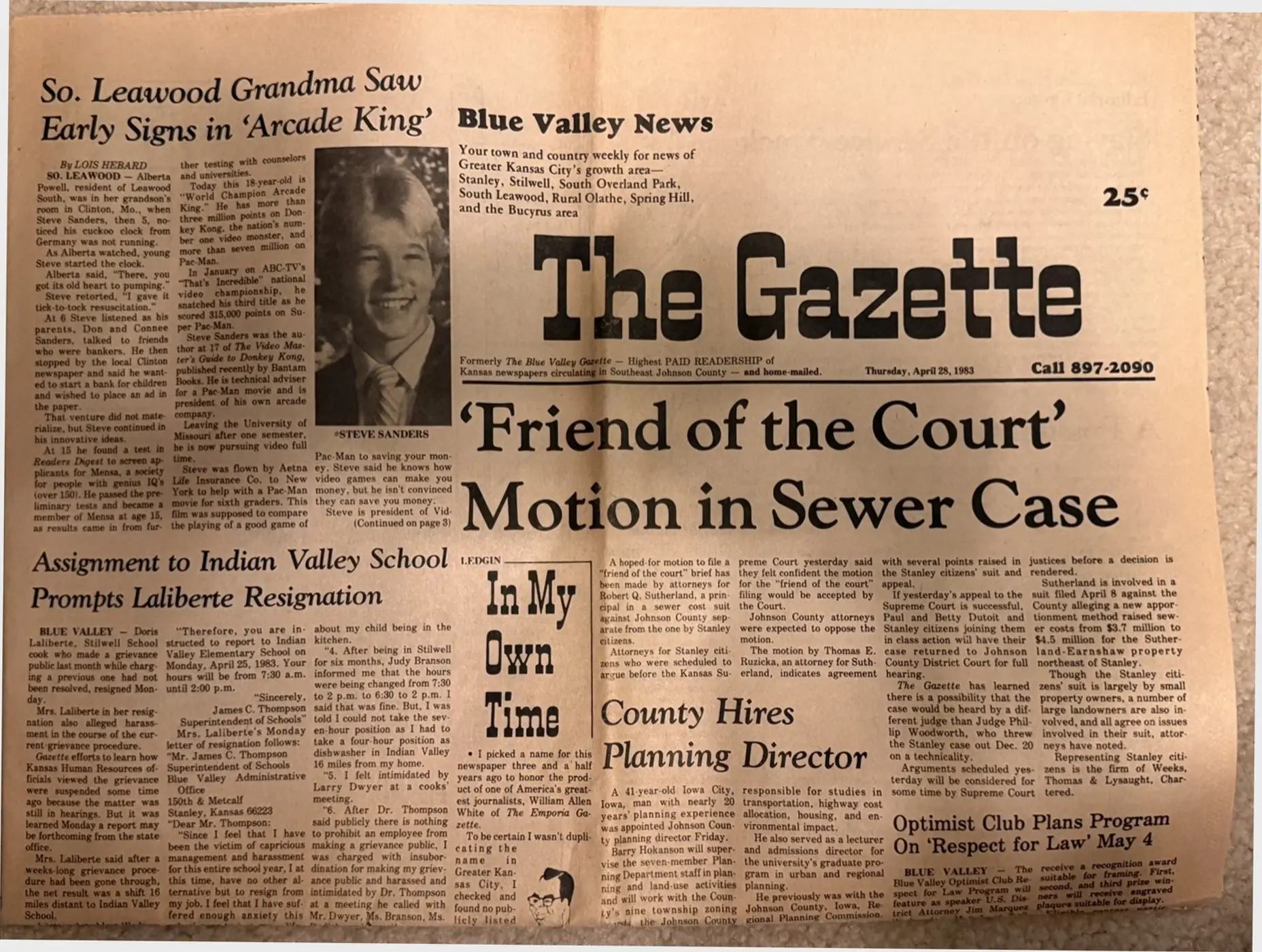
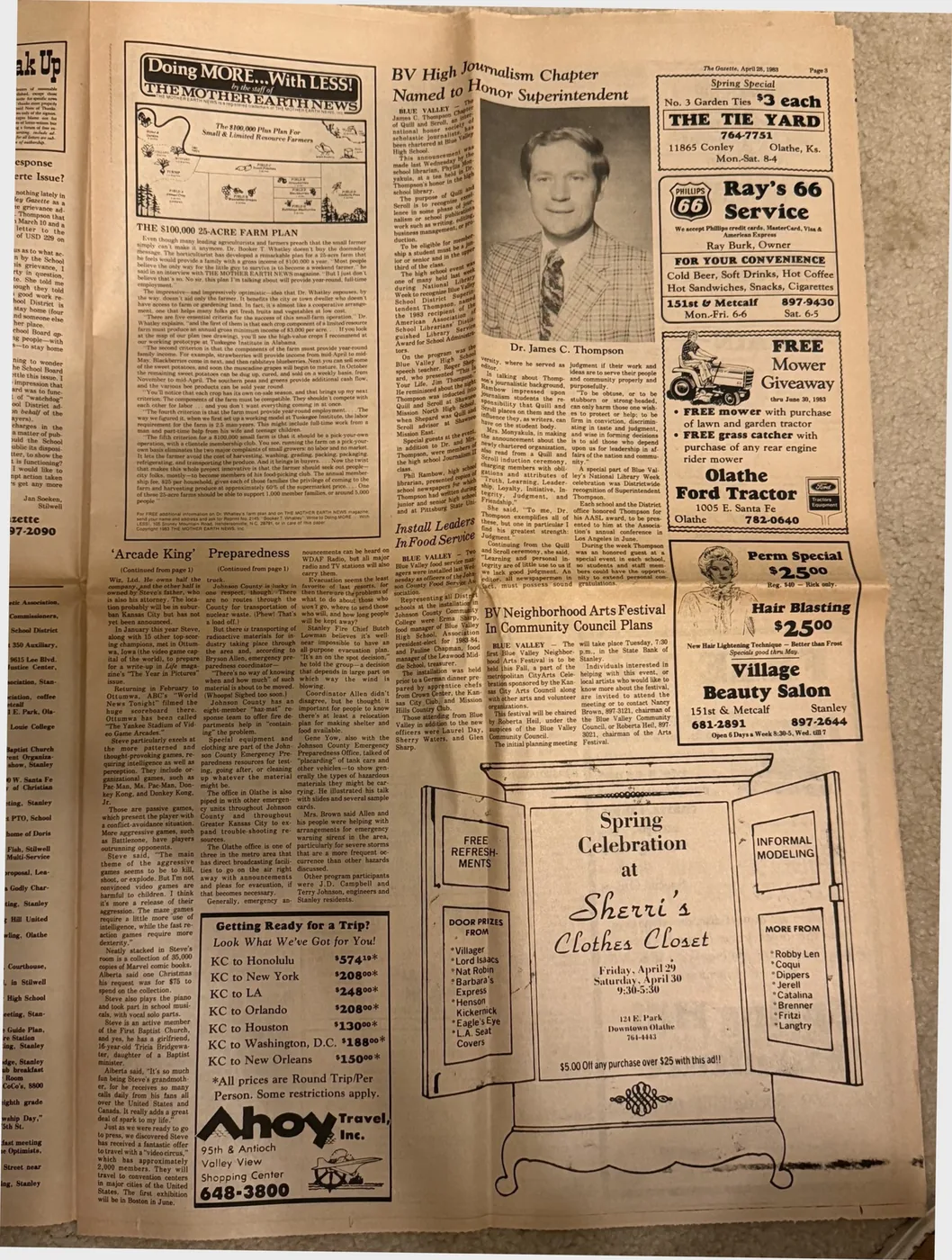
So. Leawood Grandma Saw Early Signs in 'Arcade King'
By Lois Hebard
SO. LEAWOOD — Alberta Powell, resident of Leawood South, was in her grandson's room in Clinton, Mo., when Steve Sanders, then 5, noticed his cuckoo clock from Germany was not running.
As Alberta watched, young Steve started the clock.
Alberta said, "There, you got its old heart to pumping."
Steve retorted, "I gave it tick-to-tock resuscitation."
At 6 Steve listened as his parents, Don and Connee Sanders[1], talked to friends who were bankers. He then stopped by the local Clinton newspaper and said he wanted to start a bank for children and wished to place an ad in the paper.
That venture did not materialize, but Steve continued in his innovative ideas.
At 15 he found a test in Readers Digest to screen applicants for Mensa, a society for people with genius IQ's (over 150)[2]. He passed the preliminary tests and became a member of Mensa at age 15, as results came in from further testing with counselors and universities.
Today this 18-year-old is "World Champion Arcade King."[3] He has more than three million points on Donkey Kong[4], the nation's number one video monster, and more than seven million on Pac-Man[5].
In January on ABC-TV's "That's Incredible" national video championship, he snatched his third title as he scored 315,000 points on Super Pac-Man[6].
Steve Sanders was the author at 17 of The Video Master's Guide to Donkey Kong, published recently by Bantam Books. He is technical adviser for a Pac-Man movie and is president of his own arcade company.
Leaving the University of Missouri after one semester, he is now pursuing video full time.
Steve was flown by Aetna Life Insurance Co. to New York to help with a Pac-Man movie for sixth graders. This film was supposed to compare the playing of a good game of Pac-Man to saving your money. Steve said he knows how video games can make you money, but he isn't convinced they can save you money.
Steve is president of Vid-Wiz, Ltd. He owns half the company, and the other half is owned by Steve's father, who is also his attorney. The location probably will be in suburban Kansas City but has not yet been announced.
In January this year Steve, along with 15 other top-scoring champions[7], met in Ottumwa, Iowa (the video game capital of the world), to prepare for a write-up in Life magazine's "The Year in Pictures" issue.
Returning in February to Ottumwa[8], ABC's "World News Tonight" filmed the huge scoreboard there. Ottumwa has been called "The Yankee Stadium of Video Game Arcades."
Steve particularly excels at the more patterned and thought-provoking games, requiring intelligence as well as perception. They include organizational games, such as Pac-Man, Ms. Pac-Man, Donkey Kong, and Donkey Kong, Jr.
Those are passive games, which present the player with a conflict-avoidance situation. More aggressive games, such as Battlezone, have players outrunning opponents.
Steve said, "The main theme of the aggressive games seems to be to kill, shoot, or explode. But I'm not convinced video games are harmful to children. I think it's more a release of their aggression. The maze games require a little more use of intelligence, while the fast reaction games require more dexterity."
Neatly stacked in Steve's room is a collection of 35,000 copies of Marvel comic books. Alberta said one Christmas his request was for $75 to spend on the collection.
Steve also plays the piano and took part in school musicals, with vocal solo parts.
Steve is an active member of the First Baptist Church, and yes, he has a girlfriend, 16-year-old Tricia Bridgewater, daughter of a Baptist minister.
Alberta said, "It's so much fun being Steve's grandmother, for he receives so many calls daily from his fans all over the United States and Canada. It really adds a great deal of spark to my life."
Just as we were ready to go to press, we discovered Steve has received a fantastic offer to travel with a "video circus," which has approximately 2,000 members[9]. They will travel to convention centers in major cities of the United States. The first exhibition will be in Boston in June.[10]
Corrections and notes (Sanders.Law, 2026)
- Not checked. These names do not match other family records. ↩
- Mensa admits people who score in the top 2 percent on an approved intelligence test (Mensa International); its cutoff is not an IQ of 150. ↩
- Not a world champion; see the notes that follow. ↩
- False. Steve invented his 3-million-point Donkey Kong scores. His genuine score was 270,000 on March 1, 1982 (Video Games, Aug. 1982, p. 14). This article ran three weeks after Steve's April 6, 1983 letter admitting the false scores, and it repeats claims printed earlier in The Maneater and The Kansas City Star; when the interview took place is not known. ↩
- False, and not possible: the highest possible Pac-Man score is 3,333,360 (Guinness World Records). Steve's real best was 2,886,030 (Clinton Daily Democrat, Nov. 5, 1981). ↩
- The score was 315,380, and it was not a title; he finished sixth (Twin Galaxies 1998 book, pp. 154 and 798). ↩
- The LIFE photo session was in November 1982, not January, and Twin Galaxies' 1998 book (p. 778) says sixteen other players were there. ↩
- Not confirmed. We found no other source for this filming. ↩
- Not supported. The Electronic Circus touring team was a small group of players. ↩
- It opened in July. The Electronic Circus flyer gives "BAYSIDE EXPO CENTER / DAILY 10AM-10PM / JULY 15-24" (1983). ↩
"For disgraced former Joust king Steve Sanders, there's life after the arcade," The Pitch, January 15, 2009
A knight rides a flying ostrich. His lance is sharp and true. But he’s outnumbered. A half-dozen men swoop after him astride their own devouring buzzards. The knight feints left, then spurs his ostrich to flap its wings and fly him to safety on a lean island of rock suspended in the air. A buzzard dives after him. At the last possible instant, the knight turns and thrusts his weapon through the buzzard’s rider. His victims freeze, dissolving into cubes of computer data.
With Steve Sanders at the controls, this could go on for hours. He knows exactly where his enemies are programmed to go. He knows how to make the buzzards commit suicide. Over more than two decades, he has squeezed the secrets out of Joust.
“There’s a way to get all these guys to kill themselves if you line it up right. I just can’t seem to get it right now,” he says. It’s a mid-December morning. Sanders has left his law firm to demonstrate his video-game prowess for a Pitch reporter.
In the first minutes of play, most classic arcade games establish at least the hint of a plot. In Donkey Kong, an ape has stolen your woman. In Missile Command, the country is under attack, and you’re the only one who can save the cities. Joust is more arcane. You never really understand what you’re after or why you need to kill the knights. Sanders doesn’t even know if the enemies have names.
“Watch this,” he says. He pivots his left foot and spins away from the console, his back now to the screen and his hand still on the joystick. He jerks the stick toward himself. He smiles when he hears the death rattle of the knight he just impaled.
Sanders spins back. He wants to do another trick. He covers his eyes with one hand and stands motionless. Onscreen, a buzzard hops toward his man. He nudges the stick. This one dies, too.
“I memorized the number of hops it takes. You hear it 14 times,” he explains. Sanders knows that Joust is a game of self-control: It throws out wave after wave of enemies, and your inclination is to play faster. Smart gamers slow down and make their enemies come to them on their own terms.
Apart from these moments, there’s nothing particularly flamboyant about Steve Sanders. He’s a 45-year-old civil lawyer[1]. In his office near Kansas City International Airport, a trophy case holds the Guinness World Records 2007, listing him as a world record holder for Joust in doubles. (He has remained unbeaten since scoring 600,750 points with a fellow gamer named Donald Hayes in June 2006[2].) There is also the book he published when he was a teenager and a DVD of The King of Kong: A Fistful of Quarters — a documentary, in which he appears, about his best friend’s battle to retain the world’s highest Donkey Kong score. Other than that, there are few clues that he’s the type of man to keep a $2,000 arcade-game simulator in his master bedroom. He and his wife have four children and have talked of adopting a fifth. He’s clean-shaven and tall, with good posture and a thickness that he carries well. He smiles easily.
What’s not obvious is that Steve Sanders is a pioneer.
Sanders’ bid at a unique sort of national fame began in 1982, when he was 18[3]. Arcades were at their frenzied peak of popularity. Sanders seemed to have a preternatural understanding of the twirling geometric shapes, lasers and poorly animated beasts that made up the games now referred to as classics: Donkey Kong, Centipede, Pac-Man and Joust, among others. Sanders was so good that he got a publishing deal with Bantam for The Video Masters Guide to Donkey Kong[4], which advised readers on the best way to maneuver the plumber Mario through barrels, fireballs and ladders to nowhere, until they rescued the princess. The book is now a collector’s item; a used copy on Amazon is listed for $199 at the time of this writing.
“I asked Bantam if there was anyone who kept track of these scores, because I was convinced I had to be one of the best,” he says. They sent him to Walter Day.
Day was, and remains, the gatekeeper of video-game scores. In 1982, he was in his early 30s. His interests could be kindly described as eclectic. He was born in Oakland, California, and from there established a series of careers around the country. He sold business cards. He pursued folk music and tried creative writing. He collected newspapers. He was working as an oil broker in Houston when he found what would become his life’s work.
“There was a depression in the market at the time, so I was working a side job. I started working on a book of who’s who in the petroleum industry,” Day says. “I was working with a partner on it, and one night he says, ‘I can’t take this. I can’t edit another page. I have to play Space Invaders.'”
Day had never heard of Space Invaders. He followed his partner to the nearest arcade. The spinning compass in his head had finally found true north.
“I played Gork and Berserk, and I enjoyed it so much. I loved playing video games,” Day says. “I went on the road as a traveling salesman and I would stop and play video games. When I opened my arcade in 1981, that was just an excuse to play video games.”
The arcade was Twin Galaxies in Ottumwa, Iowa. A town indistinct from hundreds of others dividing the farmland between Des Moines and Davenport, its population of fewer than 25,000 was about to experience a level of national attention that it would never again match.
It started when a 15-year-old Illinois suburbanite claimed to have broken the world record on Defender with a score of 15,963,100. Day heard about it and contacted Defender’s creators, Williams Electronics, because an Ottumwa boy had beaten him by around 9 million points. He was told that the company didn’t keep track. No one did. So Day decided to start the Twin Galaxies scoreboard. Within six months, he was getting as many as 75 calls per day from people who thought that they were the world champions at something.
“The mayor of Ottumwa proclaimed us the video-game capital of the world. Then the governor of Iowa recognized us,” Day says. “It was like Dodge City. You never knew which hot, young gunslingers were going to walk through the door to challenge each other.”
Over the next four years, Day sponsored challenges and contests under the Twin Galaxies banner. Most got press attention. The Twin Galaxies First-Annual Iron Man Contest, in July 1985, may have been the most extreme. Contestants had to play their games without pause for as long as they could. Anyone who broke the 100-hour mark earned a $10,000 prize from the Sports Achievement Association. One player was eliminated after 39 hours when oil from his hands distressed the controls. Another sat in a recliner and played Q*bert for 50 hours before collapsing from exhaustion. The winner played Joust for more than 67 hours and, on the last day, resorted to blasting himself in the face with Freon to stay awake. No one made it 100 hours, so no one earned any money.
“I’ve never really thought about it much, but the truth is, Steve was our first superstar,” Day says of Sanders. “He was the first person to find me. He was the first superstar because he was putting up high scores.”
But no one knew that Sanders was lying.
On the day that Twin Galaxies broke into the national consciousness, Steve Sanders was exposed as a fraud.
Life magazine was finishing its year-in-review issue and wanted an article on the burgeoning video-game trend. Reporters found Day the same way players had: referred by electronics companies. Day promised he could get the top players in the country to converge in Ottumwa for Life‘s photographers. Twin Galaxies was less than a year old.
Day contacted every good player he knew. Sometimes, he had to explain to the players’ parents why a 33-year-old arcade owner wanted to ship their children to the middle of nowhere for a weekend. When parents resisted, he put them in touch with Life. He wanted the publicity so badly that he paid for all the hotel rooms and picked up most of the players at the airport.
“They were young men with a dream in their pocket and stars in their eyes,” Day says. “They really wanted to be professional video-game players. That’s what we all hoped would happen.”
Sanders drove up Interstate 35 to Iowa that day in late November 1982[5]. He was excited for the recognition and the chance to meet some contemporaries — other guys who also had vanity plates that read VID-WIZ or D-KONG. But he was apprehensive. He had never reached many of the scores that they thought he had.
“The way it started was that my Donkey Kong high score was beaten, maybe by 450,000 points or something,” Sanders says. “And rather than say, ‘Oh, OK, congratulations’ or try to get the score back, I’d just say I scored more than that. And that score, the one I invented, got into the Guinness Book of World Records[6]. In retrospect, I think a lot of guys were lying.”
The weekend was cold and blustery. On Saturday night, the group was photographed in the street outside the arcade, with players hunched over their machines as cheerleaders from Ottumwa High School shook pompoms. Another photo shoot with the arcade games in a cornfield proved too unwieldy. The final session was on Sunday morning.
In between photo shoots, the world’s top gamers challenged one another. “We were good. I have no doubt we were among the best,” Sanders says. “I do think there were other people out there, probably just as good, who just hadn’t gone to the trouble to find Twin Galaxies.”
Billy Mitchell was one of the players who had found Walter Day. A gangly teenager with a wispy mustache, Mitchell had contacted Twin Galaxies two months after Sanders[7]. He would go on to hold records in multiple games, earn an award from Namco for playing a perfect game of Pac-Man, and be named Video Game Player of the Century at the 1999 Tokyo Game Show. Today, he’s often posed in photos wearing a button-down shirt and a tie patterned after the U.S. flag, his fist forward with a thumbs-up. The mustache and shaggy hair of his youth have grown into a full beard and mullet.
“If you want to see the Michael Jordan of gaming, it’s Billy,” Sanders says.
When the two squared off in Donkey Kong, Sanders couldn’t break 200,000 points a game. It was a suspiciously bad day for someone who had claimed to have broken two or three times that amount[8].
“After that, I knew they looked at me with some skepticism,” he says. Sanders returned to Kansas City thinking about what he had done. He wrote a letter.
Dear friends,
To some of you this letter will be rather shocking news….
He sent it to all the players he knew and to Walter Day.
“I think a lot of players were genuinely impressed that Steve had the sand to fess up to it and to apologize and to go on with his life,” Day says. “I think if they weren’t impressed, they had their own egos in the way, or they weren’t mature enough to realize what an amazing thing he’d done, to own up to it. I’ve always admired Steve for what he did in the face of scorn. And no matter what he’d done, the truth is, he could still play better than just about anyone else.”
Sanders could still make high scores. Six months later[9], he would get another shot at the big time.
The venue was the Bayside Expo Center in Boston.
A company called Electronic Circus had assembled a professional troupe of video-game stars as a traveling attraction. Day would be the ringmaster. He and 15 of Twin Galaxies’ high scorers would visit 40 cities[10] across North America. The public could attend and play the games, watch the champions and, if they felt bold enough, challenge them to competition. If the challenger won, he could replace the Twin Galaxies player on the tour.
The first show took place in Boston on July 15, 1983.
Billy Mitchell was 17. Electronic Circus expected him and the other kids to preserve their innocence. Their contract demanded a midnight curfew, forbade drugs and alcohol, and drew rigid guidelines on their conduct around the inevitable groupies.
“There was this guy, Jim Riley, who was running things. He said to us, ‘I want you to be like the Brady Bunch,'” Mitchell remembers. Because Sanders was the oldest[11] and billed as the team captain, he had the most interaction with Riley.
“Truth be known, we were wholesome guys,” Mitchell says. “I don’t remember a single one who smoked or drank.”
It was the first time gamers had professional contracts. It was a disaster from the start.
The team was told that they would be booked into a five-star hotel. That lasted a few days, until the bill wasn’t paid and they were locked out of their rooms, luggage still inside. They moved twice before settling on a low-rent inn.
Riley wanted them to look richer than they were. At dinners, he ordered steak and lobster for everyone. He rented a skybox for a Red Sox game.
“We were at this Red Sox game, and flying overhead was a plane flying a banner for the Circus,” Mitchell remembers. “It wasn’t necessary — he just liked presenting circumstances as he did.”
More planes with banners might have helped. There was no TV advertising, and the players were tasked with promoting themselves. Some of it was easy, like going on a local radio station. Other times, Riley gave them megaphones and told them to walk along the beach barking about the show and handing out fliers.
Electronic Circus had reportedly budgeted $5 million to buy 500 machines representing 42 of the most popular arcade games. Air Supply was booked to perform. A man was hired to wear a gorilla suit.
On opening day, Sanders expected a huge crowd, but when he looked away from his own game, he noticed rows of unmanned machines.
“I don’t know if it was tremendous mismanagement or what,” Day says. “I don’t know what happened.”
The show stayed open for five days. As their chance to be rock stars floundered, the players took out their frustrations on Sanders.
“We couldn’t pick on Riley, so we picked on Steve. ‘Steve, what are you doing? When are we going to get something to eat?'” Mitchell says. “At one point, when he knew it was going to end, he spoke to his dad about taking over the Circus. As a kid, you have big ambitions, but that was absurd.”
Fewer than 2,500 people attended[12] the show at $9 a ticket. The players never made it to the next city.
The cost of their plane tickets home, along with other expenses, was deducted from their pay.
Sanders couldn’t accept his fate. For two weeks, he hunkered in the attic above Twin Galaxies, home to a rotating cast of Day’s players, trying to figure out his next move.
“I still remember waking up in this filthy room at 6 a.m. one morning,” he says. “The carpets were all shaggy. There were cockroaches running around. It was like God spoke to me at that moment and said, ‘What are you doing here? You’re wasting your life. Go back to school and make something of yourself.’ That was the end of me trying to be a professional gamer.”
He stayed out of it for more than 20 years.
Most people felt the same way he did. Arcades closed all across the country, including Twin Galaxies on March 6, 1984, though Day continued to organize competitions under the name. Mitchell managed to survive, becoming the face of classic gaming. He also started the successful Rickey’s World Famous Restaurants and line of hot sauces.
Sanders has appeared in two documentaries, The King of Kong: A Fistful of Quarters and Chasing Ghosts: Beyond the Arcade.
Chasing Ghosts premiered in December on Showtime. The documentary focuses on every player at the Life photo shoot and the adults they became.
“That one, I’m not happy about,” Sanders says. “There’s a scene they promised me wasn’t going to be in the movie. They kept having me tell this story about trash talking back and forth with Billy and getting me to re-create it, and they got a shot of me saying a cuss word I said back then. I’m not happy about that. I don’t cuss. That’s just not me, and I don’t want my kids thinking it is.”
He has received a half-dozen fan letters — and one telling him that he’s worthless — from people who have seen The King of Kong. That film casts Mitchell as a mustache-twirling villain against nice-guy challenger Steve Wiebe in the battle over Donkey Kong’s world record. Sanders is there as Mitchell’s right-hand man, who comes to respect Wiebe’s dedication and spirit. The movie was a hit with critics and earned as much money as documentaries typically earn.
“It created a whole new wave of rivalry between people. People go insane over it,” Day says. As far as Sanders’ role, he says, “That story will be remembered and written about as one of the most astounding tales of human nature, rivalry and strangeness.”
Sanders is less philosophical.
“That’s a very, very heavily edited movie. But I’m an attorney. I appreciate crafting a narrative, and they did it very well. It’s just not truthful.”
During the filming, though, he and Mitchell started talking about the old days.
“And Billy says, ‘Why don’t you go after the Joust score again?’ And I thought, why not.”
Sanders had never gone soft on the joystick. He had always played games, even if not for fortune and glory. He just needed to practice a little more. And he needed to go to Weirs Beach, New Hampshire, home of Funspot.
“Funspot is Mecca,” he says. “If you’re going to get a high score, you have to do it in public now. If Tiger Woods shoots a 62 in his backyard, nobody cares. If he does it at Augusta, then it counts. That’s Funspot.”
His competitive spirit was wakened. In 2006, he went to Funspot and, with one of his former protégés, took the Joust doubles high score. But the single-player score remained elusive. Sanders managed only 800,500 points that year, giving him third place behind Don Morlan (who had scored 1,002,500 points in July 1984) and Donald Hayes (who would put up 1,219,000 in September 2008).
Occasionally, Sanders talks about another attempt at breaking the record. He still plays on his home machine, though not as many hours as he would need to commit for a serious run.
One Wednesday afternoon in December, The Pitch brokered a phone call between Sanders and Mitchell, who lives in Florida.
“Steve, I am so tired of hearing woulda, shoulda, coulda,” Mitchell tells his old friend. “I am sick of it. So I’m giving you an ultimatum: 365 days from today. You have 365 days from now, and I’ll give you a choice. Just like I did with Rob on his records.”
“Who’s Rob and what records?” Sanders says. He’s laughing.
“I bet Rob $1,000 he couldn’t — OK, look. I’m giving you one year from today to get the high score on Joust. Now you have an incentive. It’s either $1,000, or if you feel like a weasel, a pizza.”
“I have to pay you $1,000 if I do it?”
“If you don’t do it. Or a pizza.”
“I don’t have the — “
“Buh! Buh! Buh!” Mitchell mocks Sanders’ voice. “But I might decide to just do it. Buh!”
“I just don’t care enough.”
“Oh, you just don’t care enough. Not even for a pizza?”
“I don’t — “
“Do you want to wager or don’t you?”
“OK, fine. I’ll bet you for a pizza.”
The irony is that it’s now possible to have a career as a professional video-game player.
Johnathan “Fatal1ty” Wendel is a perfect example. The 27-year-old Wendel, who is from south Kansas City, made his name playing first-person shooters (a genre that Day never approved of because of the blood-and-guts violence). Wendel plays these games so well that he has made more than $500,000 in tournament winnings. He has also started his own business, Fatal1ty Inc., selling his own brand of gaming equipment and clothes (“Fear this Geek,” January 12, 2006).
While Wendel appreciates what his predecessors attempted, he doubts that they would survive today’s competition.
“You’re playing against a computer, so you can learn the codes and what the program is set up to do. It’s pretty easy to know what to do every single second,” he says from his new apartment in Las Vegas. “It was really cool and competitive back then, but what I do today is competing, and against the best players in the world. You have to adapt and know what your opponent is thinking and evolve. I don’t think competitive gaming really started until now. It’s cool, though. I mean, it’s cool to hear stories from back in the day.”
Day, meanwhile, sees Sanders as an example of everything that used to be good in the world of gaming but no longer is.
“Back then, it was more of a brotherhood,” he says. “Today, there’s far more tension among those people. Also, bad habits have popped up. People are playing too many games, eating bad foods, not getting out in the sun. People are up till 4 a.m. playing games without their parents knowing and eating genetically modified foods. The lifestyle has degenerated. It’s ballooned out of control. It’s not just gaming; it’s everything.”
Sanders says he’ll probably try for the singles record again, if he can find the time to make it to Funspot in the next year. But he doesn’t worry about it anymore.
“With that whole community of people who follow games, they can think whatever they want. I don’t care what any of them think about me.”
Corrections and notes (Sanders.Law, 2026)
- He was 44 at the time. ↩
- The Kansas City Star (Jan. 22, 2007) places this doubles score in the fall of 2006. ↩
- He was 17 when he signed with Bantam in early 1982 (Clinton Daily Democrat, Nov. 5, 1981, gives his age as 17). ↩
- The title is The Video Master's Guide to Donkey Kong. ↩
- Early November: the photo weekend was Nov. 5–7, 1982. Guinness World Records dates Mitchell's 874,300 to Nov. 7, 1982 (statement of June 17, 2020); JoyStik (Sept. 1983, p. 64) gives "11/82." ↩
- Steve's memory here is wrong. No edition of the Guinness Book of World Records from 1983 through 1986 lists a Donkey Kong score for him. The 1983 edition (Bantam) has no video game section. The 1984 edition (Sterling, p. 415) lists him for Super Pac-Man ("Super Pac-Man 315,380 Steve Sanders"), not Donkey Kong. The 1985 edition (Bantam, pp. 570–71; Sterling, pp. 394–95) lists Donkey Kong at 196,900 by Randy Davis, and the 1986 edition (Sterling, pp. 383–84) lists it at 874,300 by Bill Mitchell. Steve's false scores were printed by JoyStik (Jan. and July 1983), Video Games (Feb. and Mar. 1983), LIFE (Jan. 1983) and The Kansas City Star (Mar. 6, 1983). ↩
- About five months. Steve contacted Walter Day in about February 1982; Twin Galaxies' 1998 book (p. 865) dates "the discovery of Billy Mitchell" to July 1982. ↩
- Steve's published false claims were far higher: 3,151,800 and 3,165,300 (JoyStik, Jan. and July 1983). ↩
- About eight months (November 1982 to July 1983). ↩
- Accounts of the planned team size and number of cities differ, and the touring team that played was smaller (Keith Smith, "The Electronic Circus," The Golden Age Arcade Historian, Mar. 1, 2013). ↩
- He was not the oldest; teammates Eric Ginner and Darren Olsen were older (Guinness Book of World Records 1985, as transcribed by Classic Arcade Gaming). ↩
- Attendance estimates differ widely (Keith Smith, Mar. 1, 2013; Walter Day). We do not rely on a number. ↩
Today
Today Steve's work is at Sanders.Law, where he and his team hold trucking companies and other wrongdoers accountable for the harm they cause. Read Steve's full bio.
Sources
All checked Oct 20, 2026 (CT).
- "Video Game V.I.P.S.," LIFE, January 1983 ("The Year in Pictures") ("Steven Sanders, 18, Clinton, Mo., pinned 3,165,300 Donkey Kong tails"). The sources disagree on the day of the photo session, so this page says November 1982.
- "Four Score and Seven Billion Points Ago…," Video Games (Pumpkin Press), vol. 1, no. 1, Aug. 1982, p. 14 (Twin Galaxies' list: "Here are the top scores of 14 games tabulated at Day's Video Central." Donkey Kong: 270,000, March 1, Steve Sanders, Shawnee, Kan.). https://archive.org/details/Video_Games_Volume_1_Number_01_1982-08_Pumpkin_Press_US_a
- Walter Day, Twin Galaxies' Official Video Game & Pinball Book of World Records (1998), p. 79, Donkey Kong table (three-life setting: "Start: 3 Marios"): "270,000 Steve Sanders Shawnee, KS 3/1/81" (the year is a misprint for 1982). https://archive.org/details/twin_galaxies_official_video_game_and_pinball_book_of_world_records
- Walter Day and Kelly R. Flewin, eds., Twin Galaxies' Official Video Game & Pinball Book of World Records: Arcade Volume, 2nd ed. (Fairfield, Iowa: 1stWorld Publishing, 2007), p. 154, "Steve Sanders - Gaming Pioneer" (Steve's copy). This book places the 1981 Pac-Man score in Kansas City, Mo.; the 1981 newspaper says Lawrence, Kan. The same table dates the Super Pac-Man score 1/12/83; Day's 1998 book (p. 154) and Twin Galaxies card 88 date it 1/9/83, during the That's Incredible contest. Day's 1998 book (pp. 840, 844) describes the first organized team as one he formed after the Electronic Circus.
- Peter Rugg, "For disgraced former Joust king Steve Sanders, there's life after the arcade," The Pitch (Kansas City), Jan. 15, 2009. The 2007 Kansas City Star (Jan. 22, 2007) placed the 600,750 doubles score in the fall of 2006. https://www.thepitchkc.com/for-disgraced-former-joust-king-steve-sanders-there146s-life-after-the-arcade/
- Steve Sanders, 35mm slide of a Donkey Kong screen reading HIGH SCORE 863500, 1982; his label notes seven lives (Steve Sanders collection). Steve's photo, not independent verification.
- Steve Bloom, "These Guns for Hire!," Computer Games, Dec. 1983/Jan. 1984, pp. 26–30 ("In a letter to Day and twelve other high scorers, he admitted to his crime and pleaded for forgiveness"; Steve: "863,500—using seven men on the original chip"). https://archive.org/details/computer_games_dec83jan84
- "Honor Roll," Arcade Express, vol. 1, no. 5, Oct. 10, 1982 ("Donkey Kong/Nintendo – Steve Sanders, Clinton, Mo. – 863,500"). https://archive.org/details/arcade_express_v1n5
- "JoyStik Scoreboard" ("as compiled by Walter Day of the Twin Galaxies Entertainment Centers"), JoyStik, vol. 1, no. 2, Nov. 1982, p. 63 ("Donkey Kong Steve Sanders 863,500 7/10 Meadow Lark Lanes: Clinton, MO"; the year is not printed). https://archive.org/details/joystik-vol1-1692ab
- Steve Sanders, statement to the Sanders.Law team, Oct. 20, 2026 (his account).
- Steve Sanders, typed letter beginning "Dear friends," April 6, 1983, addressed to "Twin Galaxies" and twelve players, the first of them "Bill Mitchell." Only page 1 survives; Steve says page 2 is lost. Steve Sanders collection.
- Steve Sanders, statement to the Sanders.Law team, Oct. 20, 2026 (his recollection; not independently verified). His April 6, 1983 letter gives his real best at that time as "550,000 on the hard chip with 4 men," which is a four-life setting, not the three-life tournament setting described here.
- Walter Day, Twin Galaxies' Official Video Game & Pinball Book of World Records (1998), pp. 830, 833 and 837 (Electronic Circus, Boston, July 15-25, 1983; "Steve Sanders, who Riley had appointed as team captain"; Pete Corpeny). https://archive.org/details/twin_galaxies_official_video_game_and_pinball_book_of_world_records. The Electronic Circus's own flyer gives "BAYSIDE EXPO CENTER / DAILY 10AM-10PM / JULY 15-24."
- Billy Mitchell's 874,300: Guinness Book of World Records 1984 (New York: Sterling Publishing Co., 1983), p. 415, "Video Games," table "'LIFE MAGAZINE' COMPETITION": "Donkey Kong 874,300 Bill Mitchell" (the earliest Guinness listing; it gives no date and does not mention Steve or the head-to-head); JoyStik vol. 2 no. 1 (Sept. 1983), "JoyStik Charts," p. 64 ("Donkey Kong | Bill Mitchell | 874,300 | 11/82 | Twin Galaxies: Ottumwa, IA"), https://archive.org/details/joystik_magazine-1983-09; Guinness World Records, statement of June 17, 2020 ("7 November 1982 – Highest score on Donkey Kong – 874,300 Points"), https://www.guinnessworldrecords.com/news/2020/6/a-statement-from-guinness-world-records-billy-mitchell-621053. The head-to-head: Peter Rugg, The Pitch, Jan. 15, 2009 ("When the two squared off in Donkey Kong, Sanders couldn't break 200,000 points a game"); The King of Kong: A Fistful of Quarters, dir. Seth Gordon (Picturehouse, 2007), Steve Sanders interview ("I got 200,000 against Bill. Bill got 800,000 on his first man in that game. He shellacked me."). Twin Galaxies' 1998 book does not agree with itself or with these accounts: p. 778 prints Mitchell's score as 874,340 and does not mention Steve, and p. 866 says Steve did not play Mitchell face to face on Donkey Kong in the ten months after the photo session.
- Steve Sanders, The Video Master's Guide to Donkey Kong (New York: Bantam Books, 1982), copyright page: "A Bantam Book / June 1982"; "Copyright © 1982 by Steve Sanders"; first printing. Open Library OL10633403M. https://openlibrary.org/books/OL10633403M
- Patricia M. Murphy (Contracts, Bantam Books Inc.) to Steve Sanders, letter, April 29, 1982 ("On Ethan Ellenberg's behalf, I am enclosing one fully-executed copy of our agreement for DONKEY KONG, as well as the signing payment"). Steve Sanders collection.
- Google Books record (retail data; see also). https://books.google.com/books/about/The_Video_Master_s_Guide_to_Donkey_Kong.html?id=iaaHAAAACAAJ
- Open Library OL10633403M. https://openlibrary.org/books/OL10633403M
- Steve Sanders, statement to the Sanders.Law team, Oct. 20, 2026, relaying the sales figure Bantam Books gave him.
- "High Scorer," The Clinton Daily Democrat (Clinton, Mo.), Thursday, Nov. 5, 1981, vol. 112, no. 218 ("high scorer in a Pacman contest in Lawrence, Kansas that ended October 31"; 2,886,030 points; "a high school senior and is 17"). Steve Sanders collection. Steve's own letter of April 6, 1983 (shown above) gives his real Pac-Man high as 2,884,340, about 1,700 points lower than the newspaper's figure. Steve says the newspaper's 2,886,030 is the correct score and the letter's figure is a mistake (statement to the Sanders.Law team, Oct. 20, 2026).
- Walter Day, Twin Galaxies' Official Video Game & Pinball Book of World Records (1998), pp. 154 (Super Pac-Man: 315,380, 1/9/83), 790 (Jan. 8–9, 1983), 798 ("6. Steve Sanders Clinton, MO 36.97%") and 799 ("North American Video Game Olympics"). https://archive.org/details/twin_galaxies_official_video_game_and_pinball_book_of_world_records
- "That's Incredible!," Score! column, Video Games, vol. 1, no. 7, Apr. 1983, p. 75 ("just 19 of the top game players in America").
- Guinness World Records, "First videogame world champion," guinnessworldrecords.com, accessed Oct. 20, 2026 ("8-9 January 1983"; nineteen players; That's Incredible). https://www.guinnessworldrecords.com/world-records/first-person-to-become-world-champion-at-video-gaming
- Guinness Book of World Records 1984 ("1984 Edition," 22nd U.S. edition; New York: Sterling Publishing Co., 1983; David A. Boehm, Editor-in-Chief; ISBN 0-8069-0256-6), p. 415, "Video Games." Under "MASTER'S TOURNAMENT": "Joust* 4,254,950 Steve Sanders" ("* 2-hour time limit, exact"). Under "FIRST ANNUAL VIDEO GAME INVITATIONAL": "Super Pac-Man 315,380 Steve Sanders." Guinness introduces the tables as "significant scores (not necessarily records) made in major competitions under careful supervision by Twin Galaxies International Scoreboard in Ottumwa, Iowa," and does not date the competitions.
- Guinness Book of World Records 1985 ("1985 Edition," 23rd U.S. edition; New York: Sterling Publishing Co., 1984; David A. Boehm, American Editor; ISBN 0-8069-0264-7), pp. 394–95, "Video Games," table "VIDEO GAME CONTEST RESULTS": "Super Pac-Man *315,380 Steve Saunders … Clinton, MO," where "* Record set in 1983." The text on p. 394 says the table gives the results of a nationwide competition "held under the auspices of Twin Galaxies with Walter Day as coordinator, on June 29, June 30 and July 1, 1984"; Steve's entry carries the 1983 asterisk. The 1985 edition misspells the name as "Steve Saunders." Guinness also misprinted his birth date. The score matches the 1984 listing. Neither the 1984 nor the 1985 edition names the January 1983 contest, its date or That's Incredible.
- James Augustus Baggett, "The King of Kong," Star Magazine, The Kansas City Star, March 6, 1983, pp. 17–19 (photo by John Trotter). Steve Sanders collection. The same writer, credited as James A. Baggett, printed the same claims a month earlier in The Maneater's "The Mews," Feb. 4, 1983, p. 5 ("Kong King Turns Entrepreneur").
- 270,000 is the official figure. Steve's April 6, 1983 letter says that when he first called Twin Galaxies in 1982, he reported "a Donkey Kong high of 295,000 (which was true)." That score was never officially verified, and the letter does not date it. Steve's own account (statement to the Sanders.Law team, Oct. 20, 2026; not independently verified): from 1981 to 1984 he often scored between 100,000 and 300,000 on Donkey Kong, and he went over 500,000 twice, once on a four-life setting and once on a seven-life setting. His April 6, 1983 letter gives those two scores as 550,000 ("on the hard chip with 4 men") and 863,500 ("with 7 men on an easy chip machine").
- JoyStik, vol. 1, no. 4, Jan. 1983, p. 71 ("Steve Sanders 3,151,800 9/11 U-Totem: Kansas City, MO"); JoyStik, July 1983 ("Steve Sanders 3,165,300 10/2/82 Fun Factory: Kansas City, MO"). Both are scores Steve later admitted were false. https://archive.org/details/joystik_magazine-1983-01 ; https://archive.org/details/joystik-vol1-fa6548
- Steve Sanders, statement to the Sanders.Law team, Oct. 20, 2026: every false score was over 900,000.
- Retro Gamer (UK), issue 171 (2017), Donkey Kong feature, Steve Sanders: "The fact that he forgave me when I admitted it and became one of my best friends is testament to his character." Internet Archive, file "Retro Gamer UK 171." https://archive.org/details/retro-gamer-uk-2017
- "Steve Sanders: King of Kong?," Donkey Kong entry, Retro Gamer (UK), issue 150 (2016) (Steve Sanders collection). The 175,000 Steve mentions there was an earlier score from February 1982; his 270,000 came on March 1.
- Steve Sanders, statement to the Sanders.Law team, Oct. 20, 2026: filmmakers Ed Cunningham and Seth Gordon, then filming what became The King of Kong, invited the original 1980s players to sharpen their skills and, with Walter Day's help, arranged the Dodge City contest. He was invited in 2005, began practicing at home that year, and played the contest in 2006.
- Tiffany Ryan, "Attorney works to set world record in Joust," Johnson County Sun, April 20, 2006, as reprinted on the Twin Galaxies website (Steve Sanders collection).
- James Hart, "20 years removed from battle, knight defends honor in Joust," The Kansas City Star, April 10, 2006, continued on p. A4 (Steve Sanders collection).
- Walter Day's 2007 record book (p. 154, "Steve Sanders - Gaming Pioneer") gives a lower figure, "more than 2.4 million points." This page uses the number Guinness printed in 1984.
- Peter Rugg, "Steve and Isaiah Sanders, father and son video-game champs, take Joust world record for doubles," The Pitch, Jan. 21, 2011 (the online copy shows only the opening). https://www.thepitchkc.com/steve-and-isaiah-sanders-father-and-son-videogame-champs-take-joust-world-record-for-doubles/
- Twin Galaxies trading card no. 328, "Steve & Isaiah Sanders, Doubles World Champions on Arcade Joust," Twin Galaxies' Superstars of 2012 video game trading card set (© Twin Galaxies, Inc.), front and back; scan courtesy Steve Sanders, Oct. 20, 2026. Back: "The father-son duo had beaten a world record first in December, 2010 during The Tron Off at Richie Knuclez' Arcade. Their score was 745,000." and "In November 2012, at The Kong Off II, at the 1Up in Denver, CO, the Sanders men obliterated their previous score with a new world record: 881,250." Front: "1up Arcade• Denver, CO • November 18, 2012." A Walter Day / Twin Galaxies keepsake, not an independent record.
- Twin Galaxies trading card no. 127, "Joust Doubles World Record," Twin Galaxies' Superstars of 2011 video game trading card set (© Twin Galaxies International, Inc.), front and back; scan courtesy Steve Sanders, Oct. 20, 2026. Front: "Steve Sanders Kansas City, MO," "Lonnie McDonald Kansas City, MO," "Twin Galaxies Video Game Festival Ottumwa, Iowa • November 11-12, 2011." Back: a combined score of "40,120,150 points" and a playing time of "15 hours and 1 minute." A Walter Day / Twin Galaxies keepsake, not an independent record.
- "Kansas City's 'King of Kong' makes big-screen debut," Missouri Lawyers Media (staff), Aug. 17, 2007. https://molawyersmedia.com/2007/08/17/kansas-city8217s-8216king-of-kong8217-makes-bigscreen-debut/
- Ronnie Scheib, review of The King of Kong, Variety, Aug. 15, 2007 (cast: "…Walter Day, Nicole Wiebe, Steve Sanders…"). https://variety.com/2007/film/reviews/the-king-of-kong-a-fistful-of-quarters-1200557139/
- See also: Wikipedia, "The King of Kong" (tertiary). https://en.wikipedia.org/wiki/The_King_of_Kong
- James Hart, "Local man a featured arcade king," The Kansas City Star, Jan. 22, 2007 (Steve Sanders collection).
- See also: Wikipedia, "Chasing Ghosts: Beyond the Arcade" (tertiary). https://en.wikipedia.org/wiki/Chasing_Ghosts:_Beyond_the_Arcade
- Arcades & Love Songs: The Ballad of Walter Day, dir. Ed Cunningham (2025), cast listing "Steve Sanders, Self" (IMDb tt31973869). https://www.imdb.com/title/tt31973869/
- Peter Rugg, "International Video Game Hall of Fame honors but doesn't induct Joust champ Steve Sanders," The Pitch, Aug. 5, 2010 (quotes Steve: "I am receiving an award of recognition this weekend"). https://www.thepitchkc.com/international-video-game-hall-of-fame-honors-but-doesnt-induct-joust-champ-steve-sanders/
- Scott Steinberg, "The importance of video game history," CNN.com, Aug. 18, 2010, photo caption (archived). https://web.archive.org/web/20100820/http://www.cnn.com/2010/TECH/gaming.gadgets/08/18/video.game.history/index.html